Liquid Cooled Motors-190 Base Liquid cooled DC Servo Motors from Wheatstone
Water-cooled motors for new energy vehicles are currently the most common cooling solution for drive motors. The core of this system involves circulating coolant (typically a 50% ethylene glycol-water solution) inside the motor housing to indirectly dissipate the heat generated by the motor.
Key Features:
High Heat Dissipation Efficiency and Greater Sustained Power Output
Liquids have a specific heat capacity and thermal conductivity far higher than air, enabling them to rapidly dissipateheat from the stator core and windings. The motor is less prone to overheating under conditions such as hill climbing, high-speed operation, and frequent acceleration, allowing it to sustain higher power output and reduce power loss caused by “thermal decay.”
Stable Temperature Control for Improved Efficiency and Longevity
Lower winding temperatures reduce copper losses, resulting in more stable motor efficiency; at the same time, insulation materials age more slowly, the risk of permanent magnet demagnetization is reduced, and overallreliability and service life are extended.
Higher Power Density and Relatively Compact Design
Compared to air-cooled motors, liquid cooling dissipates heat more efficiently, allowing motors to be designed more compactly or to deliver greater power within the same volume, which benefits vehicle lightweighting and layout.
High Integration with Vehicle Thermal Management
The water-cooling circuit can easily share radiators, water pumps, and expansion tanks with the cooling systems for the battery and electronic control units, simplifying the vehicle’s thermal management architecture and reducing overall system cost and complexity.
Mature technology with controllable costs
The water-cooled motor supply chain is well-established, manufacturing processes are mature, and components are highly interchangeable, making it suitable for large-scale mass production. Compared to oil-cooling solutions, it does not require complex oil circuits, oil spray mechanisms, or a separate oil pump, resulting in lower design and manufacturing costs.
Excellent Sealing and Strong Environmental Adaptability
The motor housing can be designed as a sealed water jacket, providing excellent dust, water, and moisture resistance, and enabling it to withstand harsh environments such as vehicle vibrations, driving through water, and dusty conditions.
Superior NVH Performance
The liquid-cooling system does not require an air-cooling fan, reducing fan noise and aerodynamic drag, which benefits the vehicle’s quietness and energy efficiency.
Important Notes
In water-cooled electric motors for new energy vehicles, the water-cooling system plays a critical role when using the weak-magnet mode to increase rotational speed:
The weak-magnet mode generates additional copper losses and heat; water cooling promptly dissipates this heat, preventing the windings and permanent magnets from overheating.
Water cooling provides stable heat dissipation, which extends the duration of the high-speed weak-magnet mode and improves high-speed cruising and passing capabilities.
Motor Dimensions
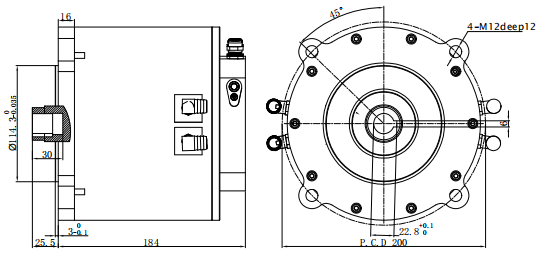
Electrical Parameters
| Main performance parameters |
| Motor Model | 190SV-16L45-YL-360V |
| Rated Power(KW) | 16.5 |
| Rated current(A) | 57 |
| Rated speed(RPM) | 4500 |
| Maximum speed(RPM) | 1800 |
| Rated Torque(NM) | 35.0 |
| Maximum Torque(NM) | 105.0 |

 86-0519-86163211,86-0519-86163212







