e-mail linda@wheatstonemotor.com         tel  86-0519-86163211,86-0519-86163212

High And Low Temperature Motors

High- and low-temperature motors are specialized motors designed specifically for extreme temperature environments. Through the use of special materials, structures, and lubrication systems, they ensure reliable operation under harsh conditions.

Design Standards:

Temperature Rise and Insulation Class Are Key

A comprehensive upgrade of the materials system is the key


Specific Industry Applications

 Aerospace
 Energy and Heavy Industry
 Advanced Research and Healthcare
 Special Environments
High temperature motors can be classified by type into high-temperature stepper motors, high-temperature servo motors, high-temperature permanent magnet motors, high-temperature reluctance motors, and high-temperature induction motors.
 
High temperature stepper motors are primarily used in applications that require precise positioning. They are characterized by the use of electrical pulses to control the angle of rotation, with each step being highly precise.

High-temperature servo motors place greater emphasis on high precision, high dynamic response, and closed-loop control—in short, they operate with high accuracy and respond quickly—and are commonly used in automated equipment that requires precise control.

High temperature permanent magnet motors operate by using permanent magnets to generate a magnetic field; they are highly efficient and compact.

High temperature magnetoresistive motors, the most typical of which is the switched reluctance motor, are characterized by the absence of both permanent magnets and windings on the rotor, resulting in an extremely simple and reliable design.

High-Temperature Asynchronous Motors this is a traditional type of motor with a simple design and relatively low cost, and it is widely used in industry.

Wheatstone classifies high-temperature motors as follows:

Classification of High-Temperature Resistance Ratings H1:Withstands temperatures up to 80°C H2:Withstands temperatures up to 120°C
H3:Withstands temperatures up to 150°C H4:Withstands temperatures up to 180°C
H5:Withstands temperatures up to 200°C H6:Withstands temperatures up to 300°C


Based on their core structure and operating principles, cryogenic motors are classified into cryogenic asynchronous motors and cryogenic synchronous motors.

Low-Temperature Asynchronous Motors With their simple structure, reliability, and relatively mature technology, they are often the preferred solution in the field of low-temperature motors.

Low-Temperature Synchronous Motors A closer look:

Low-temperature permanent magnet synchronous motors: High efficiency and high power density; they represent an important direction for development.

Electromagnetically excited synchronous motors: Complex in structure; they are rarely used in specific applications such as LNG pumps.

Wheatstone classifies low-temperature motors as follows:

Classification of High-Temperature Resistance Ratings L1:Withstands temperatures as low as -40°C L2:Withstands temperatures as low as -55°C
L4:Withstands temperatures as low as -96°C L5:Withstands temperatures as low as -196°C

High And Low Temperature Motors Features

  Determine Temperature Requirements: Based on the actual operating temperature range and the motor’s own heat generation, select a model with a higher temperature class and allow for a safety margin.


Consider the Insulation Class: In high-temperature environments, prioritize Class H (180°C) or even Class C (200°C and above) insulation classes.


Consider Protection and Heat Dissipation: Select the appropriate protection rating (e.g., IP65/IP67) based on whether the site contains moisture, dust, or other contaminants. In high-temperature environments with poor heat dissipation, forced air cooling or water cooling designs may be necessary


Other Special Requirements: If the motor will be used in environments such as vacuum, intense radiation, or salt fog, verify that it is suitable for such conditions.

Benefits of High And Low Temperature Motors

High And Low Temperature Motors feature several key characteristics and components that enable them to operate safely and efficiently in radiation-exposed areas. Let’s explore a few of these key aspects below.

High adaptability to extreme environments

It can start up and operate stably within a temperature range of -40°C to +85°C—or even wider ranges, such as -80°C to +200°C—withstanding both extreme cold and extreme heat.

 The material has excellent weather resistance.

It uses high-temperature-resistant permanent magnets (resistant to demagnetization) and special insulating materials, ensuring it is unlikely to fail at high temperatures; it also uses a specially formulated low-temperature grease that will not solidify and cause the mechanism to seize up at low temperatures.

High operational reliability

Thanks to its special structural design and material selection, it effectively withstands the thermal expansion and contraction stresses caused by alternating hot and cold temperatures, resulting in a low failure rate during long-term operation and a longer service life.

Precise Control and Smooth Operation

As an actuator, it can respond precisely to control commands (particularly in the case of servo motors), providing high-precision position and speed control, and operating smoothly. This is crucial for precision operations such as manipulating robotic arms and adjusting nuclear reactor control rods in radiation environments.

High And Low Temperature Motors Technical Data

Motor Type Motor Base Temperature Range Scope of Customization
High-Temperature Permanent Magnet Motors 40~260mm 0~200℃ Voltage, Torque, RPM
High-Temperature Stepper Motors 42~130mm 0~300℃ Voltage, Torque, RPM
High-Temperature Servo Motors 40~260mm 0~200℃ Voltage, Torque, RPM
High-Temperature Asynchronous Motors 80~400mm 0~300℃ Voltage, Torque, RPM
High-Temperature Reluctance Motors 400~450mm 0~450℃ Voltage, Torque, RPM
Low-Temperature Motors Customized Customized Voltage, Torque, RPM

Wheastone High And Low Temperature Motors Mode of Connection

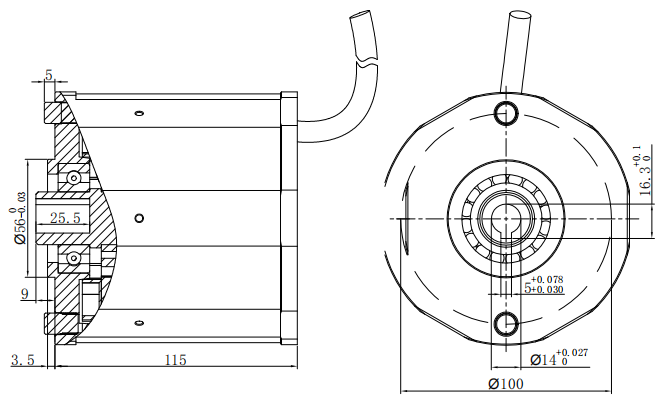
    1. High Temperature Stepper Motors Structure  
高温步进电机

High Temperature Stepper Motors
   2.High  Temperature Permanent Magnet Motors Structure    
高温永磁电机

High Temperature Permanent Magnet Motors
3.High Temperature Servo Motors Water Cooled Structure 水冷高温伺服

High-Temperature Servo Motors
4.High-Temperature Servo Motor Aviation Connector  Structure
航插型伺服电机

      High-Temperature Servo Motors

Wheatstone High And Low Temperature Motors

Can't Find ldeal High And Low Temperature Motors For Your Industries?

Wheatstone Vacuum Rated Motors Catalogue

Name Size Category Thumbnail Download
Explosion Proof Servo Motor Technical Data.pdf 89KB Catalogue download Download

Contact Us To Discuss Your High And Low Temperature Motors Needs

If there is anything you're not sure about or you just need a hand getting set-up you can call or email us.
Contact us

About Wheatstone:Your Expert Of High And Low Temperature Motors

Jiangsu Wheatstone Electrical Technology Co., Ltd. is located in Jiangsu Province, close to Shanghai and Wuxi. The company operates two factories, situated in Changzhou and Wuxi respectively.

The company specialises in the manufacture of high and low temperature motors, radiation-resistant motors, submersible motors, explosion-proof servo motors, vacuum-grade motors, AC/DC servo motors, chromatography columns and online chromatographs.

If you have any requirements for customised high and low temperature motors, explosion-proof motors or laboratory instruments, please do not hesitate to contact us……

Why Choose High And Low Temperature Motors From Wheatstone?

compliant

Quality

 
Wheatstone is known for delivering high-quality products and services that meet or exceed our customers' expectations.


reliability

Reliability

 
Our products and services are designed to be reliable, which is why our customers trust us to provide them with solutions that work.
  

lightbulb

Innovation

 
Wheatstone is always at the forefront of new technology and innovation, providing our partners with cutting-edge solutions that keep them ahead of the competition.

sketch-(1)

Customization

 
We understand that every customer's needs are different, which is why we offer customized solutions that meet their specific requirements.
    

creativity

Experience

 
Wheatstone has been in the motor industry for many years, and our experience has helped us to develop a deep understanding of the challenges that our customers face.

global

Global Reach

 
We have a strong global presence, with partners in over 70 countries, which enables us to provide our customers with support wherever they need it.
   

customer-service

Commitment to Service

 
Our commitment to providing exceptional service is at the heart of everything we do, and our partners appreciate the support we provide throughout the entire customer journey.

return-on-investment

Cost-effectiveness

 
Wheatstone offers cost-effective solutions that provide our customers with the best value for their investment, ensuring that they receive a high return on their investment.

High And Low Temperature Motors FAQ

  • Q High And Low Temperature Motors

    A 1.Why can’t standard motors be used directly in high- and low-temperature environments?

    Standard motors are typically designed to operate in ambient temperatures ranging from 0 to 40 °C; their insulation systems, lubricating grease and seals are not suitable for extreme temperatures.
    In low-temperature environments, bearing grease can solidify, leading to a sharp increase in starting torque or even seizure; at the same time, standard steel and plastic components may become brittle and prone to cracking. In high-temperature environments, conventional insulation varnish and winding wire will age more rapidly, potentially leading to insulation breakdown; standard grease will also oxidise and dry out, losing its lubricating properties and causing bearing wear.
    Consequently, specialised motors—specifically designed in terms of both materials and structure—must be selected for high- and low-temperature operating conditions.

    2.
    What are the most commonly overlooked issues when selecting high- and low-temperature motors?

    Common mistakes in motor selection mainly centre on the following three points:
    Focusing solely on temperature ratings whilst neglecting thermal cycling conditions: Paying attention only to the maximum temperature the motor can withstand, whilst overlooking the thermal expansion and contraction stresses caused by frequent temperature fluctuations in the equipment. Repeated thermal shocks can lead to issues such as the detachment of permanent magnets, cracking of the insulation layer and condensation—problems that may not occur under constant-temperature conditions.
    Focusing solely on the motor itself whilst neglecting ancillary components: Whilst the motor may be temperature-resistant, the cables, encoders and connectors connected to it may harden at low temperatures or crack at high temperatures, leading to signal loss or system failure.
    Focusing solely on power whilst ignoring torque decay: At low temperatures, internal damping within the motor increases, causing torque to decay. If sufficient torque margin is not allowed for during selection, the motor may operate normally under no-load conditions but become stuck as soon as a load is applied.

    3.What are the most common failure modes of high- and low-temperature motors in high-temperature environments?


    The two primary risks of failure in high-temperature environments are the demagnetisation of permanent magnets and the ageing of insulation.
    Demagnetisation of permanent magnets: When the motor temperature exceeds the tolerance threshold of permanent magnets (such as neodymium-iron-boron or samarium-cobalt), or when the motor is exposed to high temperatures (e.g. above 150 °C) for prolonged periods, the permanent magnets will undergo irreversible magnetic flux decay, leading to a reduction in motor torque and efficiency. If the temperature approaches the ‘Curie point’, demagnetisation will be catastrophic.
    Insulation ageing and breakdown: High temperatures accelerate the ageing of winding insulation materials, causing them to become brittle and crack. In environments subject to thermal cycling, thermal expansion and contraction further exacerbate the formation of micro-cracks, ultimately leading to insulation breakdown and motor burnout.

Consult Your Wheatstone Motor Expert

Contact us
© COPYRIGHT 2023 WHEATSTONE ALL RIGHTS RESERVED.