| Availability: | |
|---|---|
| Quantity: | |
Product Description
The WHEATSTONE High Temperature Permanent Magnet Motors.Featuring a permanent magnet rotor, it inherently offers the advantages of high efficiency and high power density. Furthermore, through the use of high-temperature-resistant materials and specially designed modifications, it is capable of long-term, stable operation at temperatures of 150°C or even higher—conditions that ordinary motors cannot withstand. It is primarily used in sectors such as aerospace, deep-well exploration and high-end manufacturing, where equipment reliability is of the utmost importance.
High efficiency and high power density:
High efficiency: As the rotor is excited by permanent magnets, there is no need to consume electrical energy to generate an excitation current, as is the case with asynchronous motors; consequently, the efficiency is inherently higher. This energy-saving advantage is particularly evident under continuous high-temperature operating conditions; case studies show that motor efficiency can remain above 92 per cent even in environments of 180 °C.
High power density: As there are no field windings, the rotor structure is more compact, enabling it to deliver greater power for the same volume; this is crucial for space-constrained applications such as aerospace and deep-well exploration.
Key Challenge: Pushing the Limits of Material Performance:
Thermal stability of permanent magnets: This is the most critical challenge. Ordinary neodymium-iron-boron permanent magnets face a risk of demagnetisation at around 150 °C, and their performance declines sharply as the temperature rises. Consequently, high-temperature permanent magnet motors must utilise high-temperature-resistant grades of permanent magnets, such as samarium-cobalt (SmCo), which can operate at temperatures as high as 350 °C; at even higher temperatures, aluminium-nickel-cobalt materials may need to be considered. Research has clearly demonstrated that samarium-cobalt motors outperform neodymium-iron-boron motors, and that the operating temperature of the permanent magnets should ideally be kept at 200 °C or below.
Upgrading the insulation system: Ordinary insulating varnishes and electromagnetic wire age rapidly and fail at high temperatures. Consequently, Class H (180 °C) or even Class C (above 200 °C) insulation materials must be used, such as polyimide film and mica tape; in extreme cases, ceramic insulation may even be required.
Lubrication and Structural Materials: Ordinary grease volatilises and fails at around 150°C, necessitating the use of specialised lubricants such as perfluoropolyether grease, which can withstand temperatures up to 300°C. Furthermore, the magnetic properties of silicon steel sheets and the thermal expansion coefficients of structural components undergo non-linear changes with temperature, increasing the complexity of design and calculation.
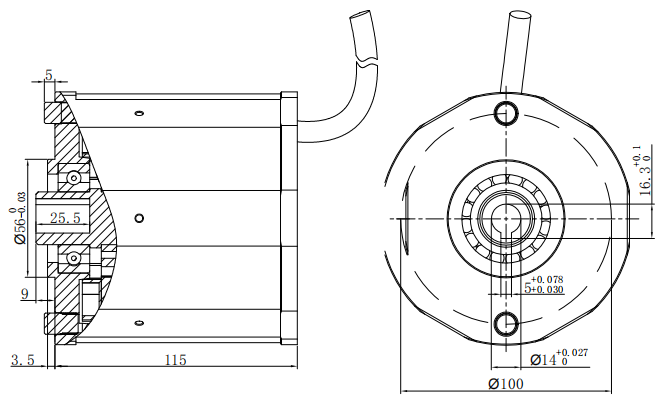
Motor Dimensions

Electrical Parameters
| Main performance parameters | |||
| Rated Power(KW) | 0.8 | Rotor of Inertia(Kg.cm²) | 4 |
| Rated Voltage(V) | 380 | Insulation Class | C |
| Rated Current(A) | 2.6 | Weight(kg) | 6.5 |
| Rated Torque(NM) | 6.7 | Ambient Temperature(℃) | 80 |
| Rated Speed(RPM) | 1200 | ||
Application Industry
The applications of high-temperature permanent magnet motors all centre on the same requirement: to provide efficient, reliable and precise power output in extreme high-temperature environments where conventional motors are unable to perform.
1.Aerospace: Coping with Extreme Temperature Variations in Space
This is the field with the most stringent requirements regarding motor size, weight, power density and high-temperature resistance.
Typical scenarios: Spacecraft such as lunar probes and Venus probes are directly exposed to space, where temperatures on the sun-facing side can exceed 180°C and even approach 460°C, with no effective means of heat dissipation. Temperatures near the nozzle of an aircraft engine can reach 350°C, and the motor for the fuel pump must also be capable of operating at these high temperatures.
Key requirements: The motors must be compact, have high power density and high efficiency, whilst being able to withstand thermal shock, vacuum and radiation environments.

2.Oil and Gas Extraction: Venturing Deep into High-Temperature, High-Pressure Underground Environments
This is one of the most mature areas for the large-scale, commercial application of high-temperature permanent magnet motors, primarily addressing the challenges of extracting oil from deep and complex wells.
Typical application: Driving submersible electric pumps at depths of several thousand metres to transport crude oil to the surface. Temperatures in low-temperature oil wells can reach 150°C, whilst those in high-temperature oil wells can reach 220°C. The motor must be installed within a narrow casing with a diameter not exceeding 140 mm, whilst withstanding pressures in excess of 210 MPa.
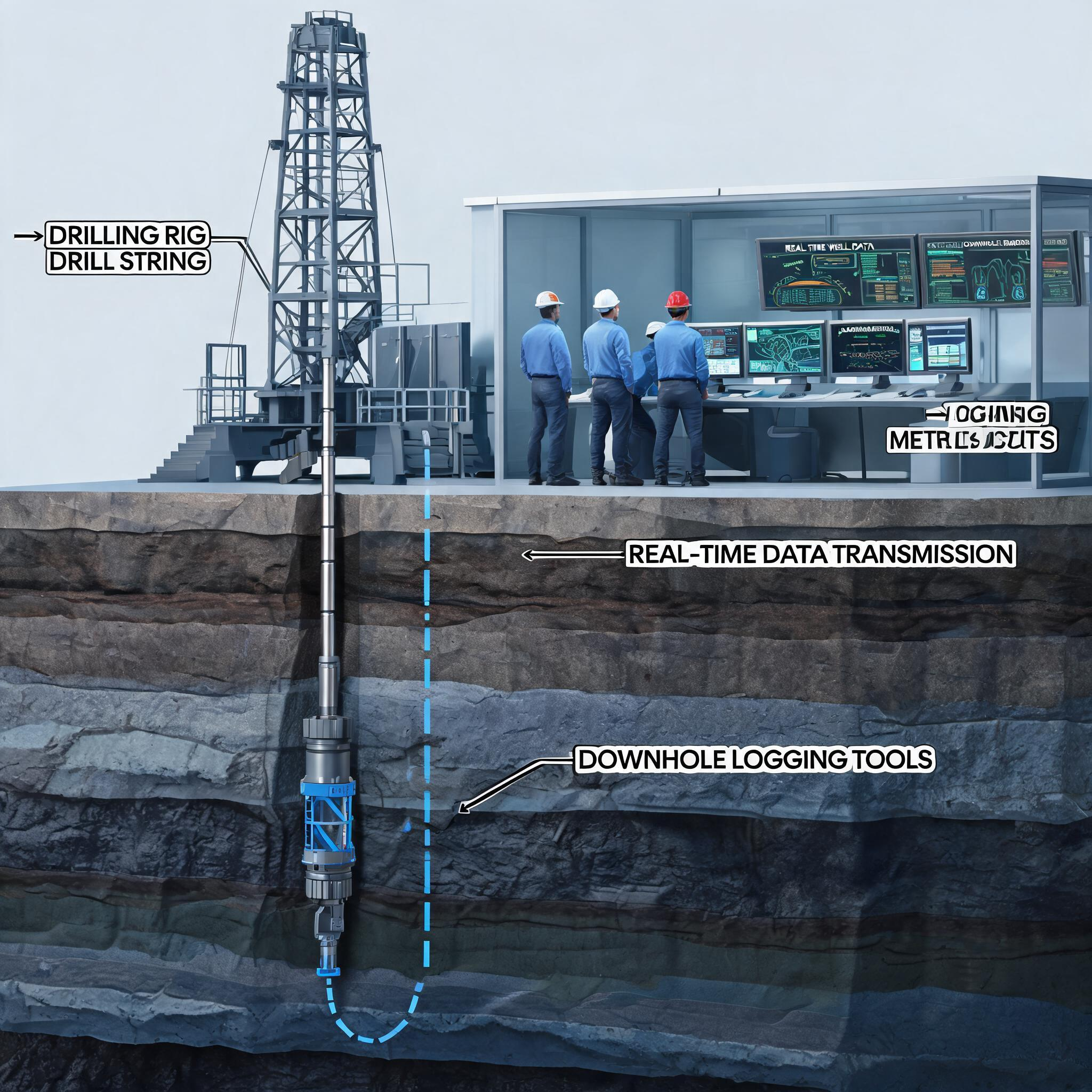
3.Specialised Industry and Fire Safety: Coping with Extreme Operating Conditions
Flue ventilation: In the event of a fire in a building or industrial flue, the motor must be capable of operating continuously to extract toxic fumes, thereby ensuring the safety of escape routes.
Large boilers and deep-well exploration: These environments are also characterised by high temperatures of around 200°C, requiring motors with the appropriate heat resistance.