Explosion-proof servo integrated motors: Are they really a blessing or just another headache? People who've used them tell the truth
Last winter, an equipment manager at a chemical plant in Germany posted on social media: "Just replaced with a new explosion-proof integrated servo motor. Day seven, and it's dead again. The supplier says it's 'normal.' I just want to know—is this what 'normal' really means?"
The comments section exploded. Some complained, "Integrated motors are a scam—if anything breaks, you replace the whole unit." Others said, "Sure, wiring is simpler, but the cooling can't handle it." One added, "Encoder alarms every other day—who dares use that in a hazardous area?"
Later, that manager asked me a question I'll never forget: "Wheatstone makes integrated motors too. Are yours the same?"
I said, "The problems you ran into? They're the three most common pain points in this field: cooling bottlenecks, fragile encoders, and no repairability. But let me walk you through where these problems come from—and how Wheatstone solved them one by one."
I. "Inherent Flaws" or "Design Laziness"?
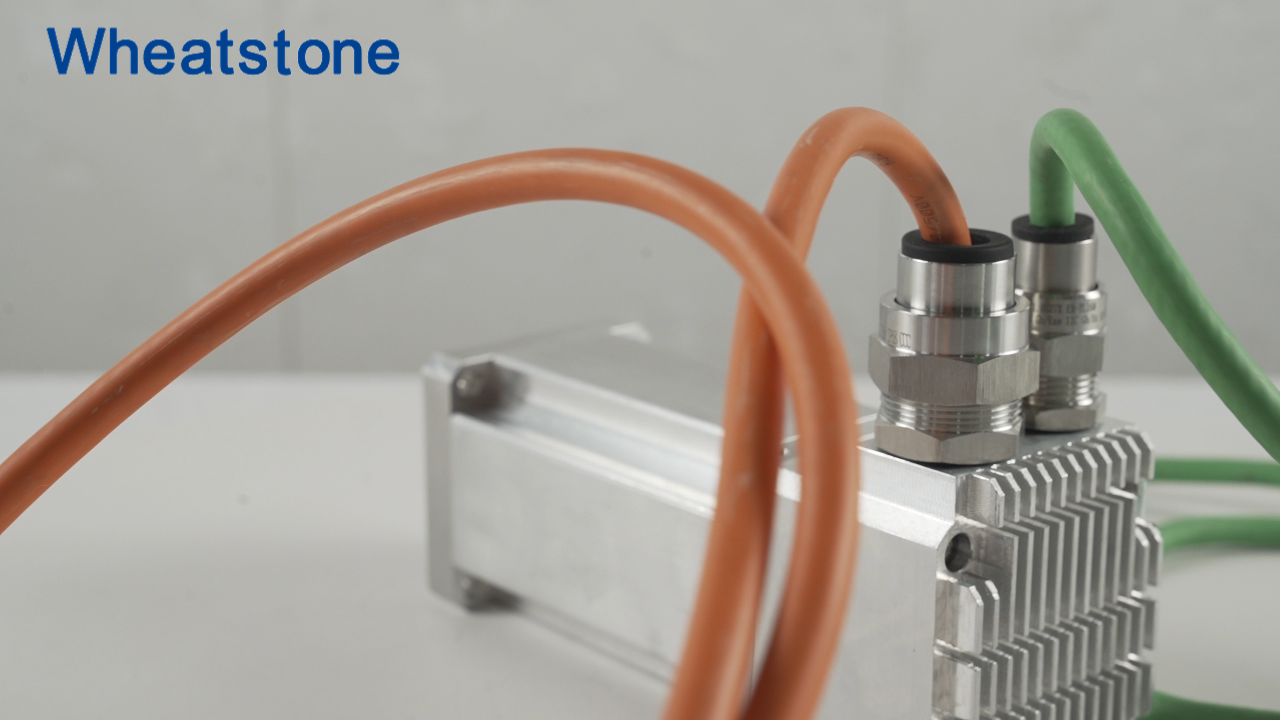
An explosion-proof integrated servo motor stuffs both the motor and drive into one housing, then wraps it in an explosion-proof enclosure. Sounds great: less wiring, smaller footprint, no need for a separate drive cabinet in hazardous zones. So why do some people swear they're terrible?
Pain Point #1: Cooling is a Hard Problem
Standard motors cool through their housing. Drives use fans. Separate systems. An integrated motor crams both heat sources into the same explosion-proof box. Heat builds up. Fast. Users report some brands hitting 95°C case temperature after just two hours continuous run, triggering drive thermal shutdown.
How Wheatstone Fixed It
We didn't just cram a drive in and call it done. Wheatstone integrated motors use a "heat source separation + composite conduction" design: the drive's power devices sit directly against a thermal pad, conducting heat through high-thermal-conductivity grease to the housing fins. The stator core and housing? Thermal interference fit—zero gap, zero thermal resistance. Two heat paths, no interference.
Test data: Wheatstone integrated motor, 40°C ambient, rated load continuous run for 8 hours. Maximum case temperature: 82°C. Drive internal temperature: consistently below 65°C—way below thermal protection limits.
Pain Point #2: Encoders "Suffocate" Inside Explosion-Proof Housings
What do encoders hate? Heat. Vibration. Oil mist. An integrated motor has all three. Standard encoders don't last long in explosion-proof environments. Signal drift, lost pulses, constant alarms—eventually, shutdown.
How Wheatstone Fixed It
We spec our integrated motors with military-grade high-temp resolvers. No electronics, no fear of heat or oil. Signal transmission is electromagnetic, rock stable from -55°C to +155°C. Paired with Wheatstone's in-house decoding board, we hit 23-bit precision—better than ordinary optical encoders.
One chemical plant's painting robots have been running for three years. Not one encoder failure.
Pain Point #3: Whole Unit Replacement When Something Breaks?
This is what users fear most: motor fails, you have to remove the drive. Drive fails, you have to remove the motor. Turns out it was just a tiny capacitor, but no one can fix it. Replace the whole unit—tens of thousands down the drain.
How Wheatstone Fixed It
Wheatstone integrated motors are modular. The drive module detaches from the motor—replace independently. The motor detaches too—repair or replace separately. Seals, glands, encoders? Standard parts. You can buy replacements. No whole-unit scrap.
Last year, a refinery in Shandong had an integrated motor running for two years. The drive's cooling fan bearing got noisy. The client bought the same fan model, watched our video tutorial, swapped it in 20 minutes. Saved over ten thousand in factory return costs.
II. Two Real-World Cases: How Wheatstone Integrated Motors Survive
Case #1: Auto Painting Line in Nanjing, 24/7 Operation
The client used Wheatstone TYCXP series integrated motors, Ex d IIB T4, 7.5kW, 23-bit absolute encoder. Mounted on reciprocating sprayers, running 20+ hours daily, 3-second cycle time. Fourteen months straight.
One incident: an operator accidentally sprayed cleaning solvent directly on the motor. Solvent seeped through the gland, shorted the drive.
Wheatstone service arrived. Inspection: three MOSFETs burned on the drive module. Replaced with a spare drive module (client stocked one), re-commissioned parameters. Two hours later, back online. Motor and encoder? Unharmed.
Client's feedback: "If we had to replace the whole unit, we'd be waiting a week. This line would be dead."
Case #2: Natural Gas Purification Plant in Sichuan, Outdoor Unmanned Station, -20°C to +45°C Swing
This project used Wheatstone TBYC series integrated motors, Ex d IIB T4, 15kW, with anti-condensation heaters. Outdoor pump station: summer scorching, winter freezing. No one on site.
First winter: record cold snap, -25°C. Site report: motor started normally. No abnormal noise. No alarms.
Inspection: anti-condensation heater had automatically kicked in, internal temperature maintained above -5°C. Grease fluid. Encoder signal stable. Client said, "Our previous imported brand? It wouldn't even start in this weather."
III. Wheatstone Explosion-Proof Integrated Motor Selection Guide
| Series | Power Range | Voltage | Encoder | Cooling | Typical Applications |
| TYCXP Series | 0.4-7.5kW | 380V/220V | 23-bit abs/Resolver | Natural | Painting robots, reciprocators, rotary tables |
| TBYC Series | 7.5-315kW | 380V/660V | Resolver/Incremental | Air/Water | Pumps, fans, conveyors |
| Custom Series | Custom | Custom | Custom | Custom | Special applications |
IV. Future Trends: Integrated Motors Aren't a "Transition Product"—They're the Future
Industry 4.0 pushes toward smarter field devices and less wiring. Explosion-proof integrated motors fit right in:
Standardized Interfaces: Future integrated motors? Power in, bus out. Black box in between. Users just use.
Smart Diagnostics: Wheatstone's next-gen is already in testing. Built-in vibration and temp sensors, data direct transmission cloud, predicts failure before it happens.
Modular 2.0: Drive modules will be "quick-release." Swapping a drive will be as easy as changing a battery.
Final Thoughts
That manager eventually tried a Wheatstone integrated motor. Three months later, he messaged me: "I was too quick to judge. Turns out, integrated motors aren't the problem—it's the ones where companies just cram a drive in a box and call it a 'new product.' Yours? Different story."
Are explosion-proof integrated motors worth it? Depends on the design underneath. Wheatstone has spent over a decade in this game. Materials, cooling, encoders—every detail sharpened by real projects.
If you're still on the fence, let's talk. We've got plenty of stories about people who stepped in holes so you don't have to.

 86-0519-86163211,86-0519-86163212







