In cutting-edge fields such as semiconductor manufacturing, optical coating, and new energy material preparation, thin film deposition equipment is the core process tool determining product performance. Whether Physical Vapor Deposition (PVD) or Chemical Vapor Deposition (CVD), these systems operate in high-vacuum environments with stringent requirements for chamber cleanliness, thermal stability, and motion precision.
The vacuum motors driving wafer stage rotation, target shutter actuation, and transfer robot arms are the silent guardians of these atomic-level processes. Every rotation, every vibration, and every potential molecule released directly impacts film uniformity, purity, and ultimately chip yield and performance . This article analyzes the core requirements of thin film deposition equipment for vacuum motors, presents case studies with selection calculations, and demonstrates the technical depth of Jiangsu Wheatstone vacuum motors.
I. Industry Pain Points in Thin Film Deposition: The "Four Trials" for Vacuum Motors
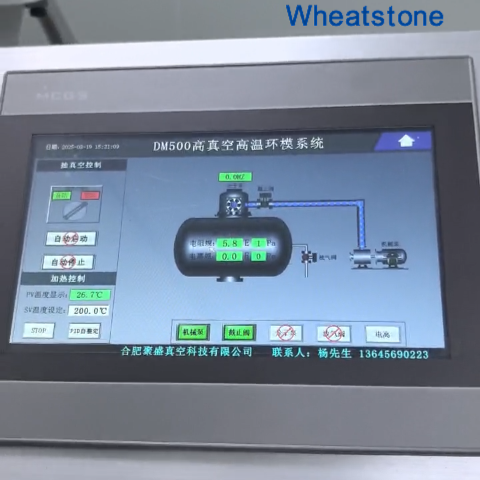
Deposition processes demand far more from motors than simply "running in vacuum." Based on industry practice and standards, four major pain points exist :
Ultra-Low Outgassing and Extreme CleanlinessDeposition chambers require ultra-high vacuum down to 10⁻⁴ Pa and beyond. Organic materials inside motors—insulating varnishes, lubricants, sealants—continuously release gas molecules in vacuum. These hydrocarbons contaminate the process environment, causing film purity reduction, impurities, and poor adhesion, directly impacting chip performance . This is the foremost concern in deposition equipment.
High Thermal Load and Magnetic StabilityPlasma processes generate significant heat, with chamber temperatures reaching 150°C or higher. High temperatures can irreversibly demagnetize standard permanent magnets, causing torque decay and performance drift thatseverely affectprocess repeatability .
Chemical Corrosion and Plasma ErosionEtch and deposition processes use highly corrosive gases like fluorine and chlorine compounds. High-energy plasma bombards exposed surfaces. Ordinary metals and coatings rapidly corrode and flake, generating particle contamination .
Nanometer-Level Motion Precision and StabilityWafer positioning and shutter operation require sub-micron repeatability. Any minute vibration or speed ripple from the motor is magnified into film thickness non-uniformity or pattern defects .
II. Wheatstone's Technical Deconstruction: Comprehensive Engineering from Materials to Systems
Addressing these challenges, Wheatstone custom vacuum motors for semiconductor front-end equipment undergo comprehensive engineering Heavy broussonetia papyrifera .
Material-Level Clean StartWheatstone vacuum motors control outgassing at the material source. Structural components use vacuum-melted stainless steel with electropolishing to minimize surface adsorbed gas. The revolutionary inorganic insulation systemreplaces traditional organic magnet wire with ceramic-insulated windings, achieving total outgassing rates below <1×10⁻¹⁰ Torr·L/(sec·cm²). Every motor undergoes rigorous Total Mass Loss testing with material outgassing data reports .
Active Thermal Management DesignAddressing the absence of convection in vacuum, Wheatstone developed "stator-rotor synergistic cooling" topology . Coolant flows not only through the housing but also through hollow shafts to directly cool rotor magnets—far more efficient than traditional methods . Combined with high-temperature Samarium Cobalt magnets, demagnetization curves remain flat above 150°C, ensuring torque decay **below 5%**at high temperatures .
Bearing Systems Engineered for VacuumTo address lubricant volatilization and carbonization, Wheatstone offersgradationsolutions :
Solution A (Ultra-High Vacuum) : Full ceramic bearings + dry film lubrication, completely eliminating oil vapor contamination.
Solution B (High Vacuum) : Specialty stainless steel bearings + PFPE vacuum grease with extremely low vapor pressure (<10⁻¹⁰ Torr).
Molecular Armor and Zero-Backlash PrecisionOn surfaces exposed to corrosive gases, Wheatstone applies PVD coatings like diamond-like carbon or yttrium oxide for molecular-level protection . The design promotes frameless torque motor direct drive, eliminating transmission backlash, with hybrid ceramic angular contact bearings achieving zero-clearance and nanometer-stable motion .
III. Case Study: PVD Magnetron Sputtering Equipment
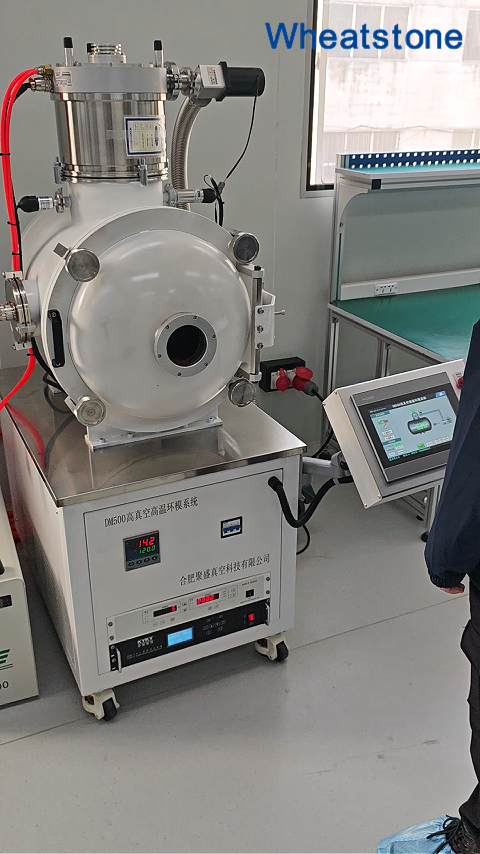
In a typical magnetron sputtering PVD system, Wheatstone vacuum motors play decisive roles at critical points :
Wafer Stage Rotation Motor
Process Requirement: Ultra-constant speed rotation at 30-120 RPM with minimal ripple.
Pain Point: Standard motor low-speed pulsation causes film thickness non-uniformity.
Wheatstone Solution: Frameless direct-drive torque motor with high-resolution encoder achieves <0.1% speed ripple—the foundation for ensuring within-wafer non-uniformity (WIWNU) better than 1%.
Target Shutter Valve Drive Motor
Process Requirement: Millisecond-level fast response for precise deposition control.
Pain Point: Slow response and inaccurate positioning compromise process windows.
Wheatstone Solution: High-speed vacuum servo motor with high torque-to-inertia ratio and optimized drive achieves actuation times <30ms with repeatability ±3 arcseconds .
Vacuum Transfer Robot Joint Motor
Process Requirement: Smooth, vibration-free wafer transfer between chambers.
Pain Point: Vibration generates particles, contaminating wafers.
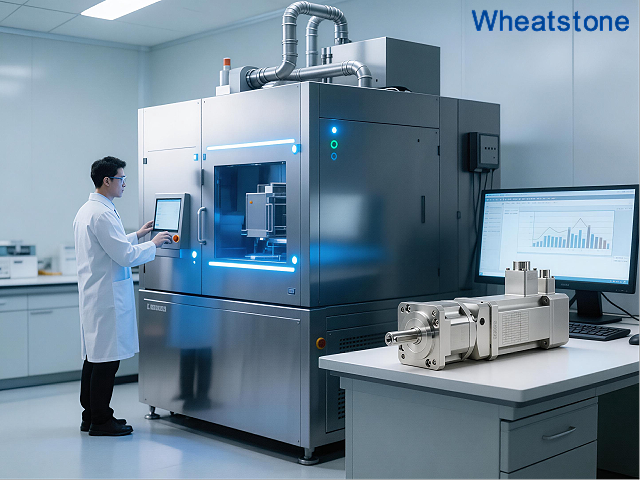
Wheatstone Solution: Fully sealed design with self-lubricating ceramic bearings, rotor dynamics optimized through FEA to eliminate micro-vibration particle generation .
IV. Selection Calculation Example: Wafer Stage Rotation Motor
Assume a PVD system requires a rotation motor for 12-inch wafer stage with:
Load Inertia (J_load) : Estimated wafer + stage total ≈ 0.015 kg·m²
Target Speed (n) : Max 120 RPM, requiring high uniformity
Acceleration Time (t) : 0.5 seconds to reach speed
Vacuum Requirement: Better than 5×10⁻⁵ Pa
Ambient Temperature: Chamber bakeout up to 120℃
Step 1: Motor Type Selection
High vacuum plus bakeout requires low-outgassing, high-temperature design. Wheatstone VX-H Series is suitable.
Step 2: Load Torque Calculation
Assume steady-state running torque T_load ≈ 0.3 Nm (friction).
Acceleration torque T_acc = J_load × (2π × n / 60) / t = 0.015 × (2×3.14×120/60) / 0.5 ≈ 0.38 Nm.
Peak torque T_peak = T_acc + T_load ≈ 0.68 Nm.
Step 3: Inertia Matching and Motor Selection
Select motor with rotor inertia J_m ≈ 0.005 kg·m², achieving inertia ratio J_load / J_m ≈ 3 (ideal for high dynamics). Wheatstone VX-H frameless torque motor specifications:
Rated Torque T_rated = 0.8 Nm
Peak Torque T_max = 2.0 Nm
Rotor Inertia J_m = 0.0045 kg·m²
Torque and inertia requirements are satisfied.
Step 4: Thermal and Outgassing Verification
Confirm motor uses SmCo magnets, PFPE grease, ceramic bearings, and glass-sintered terminals, rated for 150℃ with high-vacuum compatible outgassing.
V. Wheatstone System-Level Advantages
Beyond component excellence, Wheatstone builds reliability at systems level :
Design Redundancy: Dual-encoder options for critical applications.
Predictive Maintenance: Integrated temperature and vibration sensors with vacuum feedthroughs for health monitoring.
Collaborative Simulation: Multi-physics simulations during design phase to validate real-world performance.
VI. Wheatstone Complete Motor Product Line and Certifications
Founded in 2003, Jiangsu Wheatstone has developed comprehensive specialty motor coverage :
Complete Product Range
By Type: Explosion-proof servo motors, explosion-proof stepper motors, brushless DC motors, DC servo motors, permanent magnet synchronous motors, frameless torque motors, axial flux motors, robot joint motors
By Application: Vacuum motors, radiation-resistant motors, mining explosion-proof motors, deep-sea motors, high/low temperature motors
Technical Coverage
Frame Size: 40mm - 400mm
Power Range: 50W - 200kW
Voltage: DC 24V - 3000V / AC 220V - 1140V
Temperature: -196℃ to +200℃
Vacuum: Up to 1.0×10⁻⁷ Pa
Radiation Tolerance: Up to 1.0×10⁷ Gy cumulative
Authoritative Certifications
Quality Systems: ISO9001, TS16949
Environmental: ISO14001
Domestic: China Classification Society (CCS) type approval, CCC, Class I coal mining Ex, Class II gas Ex, Class III dust Ex
International: IECEx, ATEX, CE, ROHS
Honors: Jiangsu Gazelle Company, Jiangsu Specialized & Sophisticated SME, Jiangsu High-Tech Enterprise
From atomic-level thin film deposition to extreme deep-sea pressures, Wheatstone delivers reliable, efficient, and precise specialty motor solutions through nearly two decades of accumulated expertise and "one-customer-one-solution" customization capabilities.

 86-0519-86163211,86-0519-86163212







