In extreme environments where liquid nitrogen boiling point (-196°C) coexists with ultrahigh vacuum (10⁻⁵ Pa to 10⁻⁷ Pa), standard motors fail: grease solidifies, insulation embrittles, seals leak, and metallic components may shrink unevenly. Motors that can operate reliably under this dual extreme are critical for aerospace, semiconductor, superconductivity research, and biobanking. Jiangsu Wheatstone has developed a full series of ultralowtemperature vacuum motors for -196°C and UHV conditions, combining widetemperature materials, ultralow outgassing insulation, oilfree/solid lubrication, and allmetal sealing – providing reliable power for space simulators, cryogenic wafer probers, superconducting test systems, and biobanks.
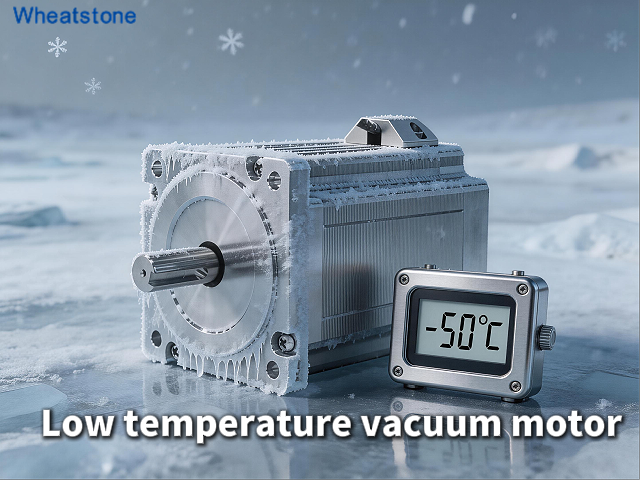
I. Five Extreme Challenges at -196°C and UHV
Lubricant solidification and volatilisation: Standard greases solidify below -50°C; even if not frozen, they volatilise in vacuum. At -196°C, almost no liquid lubricant is usable.
Thermal contraction and embrittlement: Differential thermal expansion causes clearance changes and bearing seizure; ordinary steel may become brittle; insulation materials (polyester, epoxy) crack.
Outgassing and condensation: Organic materials outgas water vapour and hydrocarbons in UHV; at -196°C, these gases condense inside the motor or on chamber surfaces, causing contamination.
Seal failure: Rubber Orings lose elasticity completely at -196°C; dynamic shaft seals are extremely challenging.
Ice crystal damage: Residual moisture in the motor freezes during cooldown; repeated thermal cycling can crack winding insulation.
II. Wheatstone‘s Core Technologies
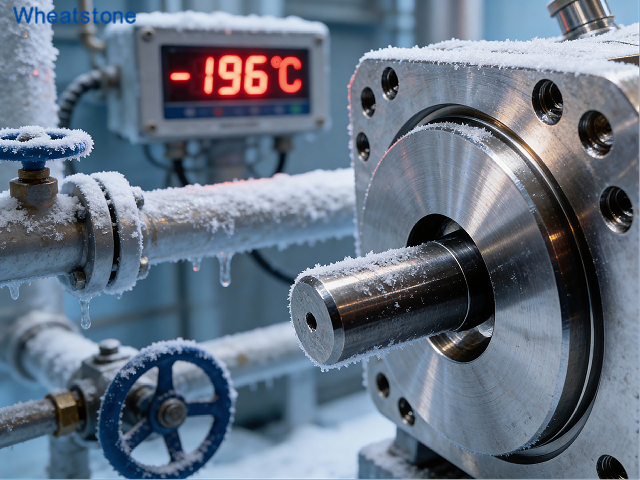
Widetemperature materials
Insulation: Polyimide (PI) filminsulated magnet wire (Tg >300°C), remains intact at -196°C. VPI with solventfree resin creates lowoutgassing dense insulation.
Metals: Austenitic stainless steel (316L) or Invar alloy – maintain toughness and dimensional stability.
Magnets: Samarium Cobalt (SmCo) – negligible flux decay at -196°C, no demagnetisation risk.
Oilfree / solid lubrication
Full ceramic bearings (silicon nitride balls) with solid lubricant coatings (MoS₂ or DLC) – no grease, no solidification, no outgassing. Ceramic thermal expansion is only 1/3 that of steel.
For less demanding cases: PFPE lowtemperature grease (pour point <-70°C, vapour pressure <10⁻¹² Torr) remains usable at -196°C.
Allmetal sealing and anticondensation
Static seals: Metal Crings or welded joints – no rubber Orings.
Dynamic seals: Ferrofluidic seals – operate from -196°C to +150°C under UHV.
Terminals: Glasssintered hermetic feedthroughs (leak rate <10⁻⁹ Pa·m³/s).
Anticondensation: Internal drynitrogen purge or precooldown heater.
Outgassing control
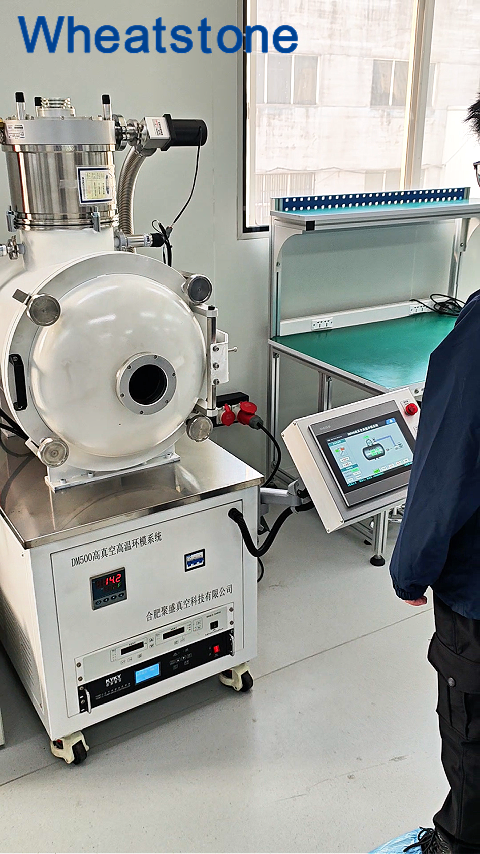
TML <0.1%, CVCM <0.01% per ASTM E595. All metal parts are ultrasonically cleaned and vacuumbaked (200°C, 48 h).
Precision feedback
23bit absolute encoder or resolver (cryogenicrated) – position accuracy ±0.01°.
III. Application Cases
Aerospace: Space environment simulator
A Wheatstone frameless vacuum servo motor (full ceramic bearings, solid lubrication, 316L housing, glasssintered terminals) drives a sample stage in a space simulator at 10⁻⁶ Pa, cycling from -196°C to +120°C. It has run over 2,000 hours with positioning accuracy ±0.01° and no lubrication or outgassing failure.
Semiconductor: Wafer cryogenic prober
A Wheatstone 42 mm vacuum stepper motor (PFPE grease, ceramic bearings) drives a probe arm at 10⁻⁵ Pa, -196°C, achieving ±5 μm repeatability for over 5,000 hours.
Superconductivity research: Material test system
A Wheatstone custom vacuum frameless servo motor (solid lubrication, nonmagnetic materials) drives a sample rotator at 10⁻⁶ Pa, -196°C for 3 months continuously without vacuum breach or sample contamination.
Biobanking: Cryogenic sample storage
A Wheatstone vacuum stepper motor (316L housing, metal seals) drives a sample retrieval arm in a liquidnitrogenfilled, vacuuminsulated biobank. It has operated intermittently at -196°C for 2 years with no seizure or seal failure.
Special industrial: Optical coating at cryogenic temperature
A Wheatstone vacuum servo motor (PFPE grease, ceramic bearings) rotates a substrate at -196°C (10⁻⁴ Pa) for a spacetelescope mirror coating run of 400 hours, achieving film uniformity <0.5%.
Defense research: Infrared detector calibration
A Wheatstone vacuum BLDC motor (solid lubricant, lownoise) drives a blackbody target wheel at 10⁻⁵ Pa, -196°C for over 1,000 hours during detector calibration.
IV. Selection Guide
| Series | Temp range | Vacuum | Lubrication | Encoder | Typical applications |
| LVT Stepper | -196~+80°C | 10⁻²~10⁻⁵ Pa | PFPE grease / ceramic+ solid lube | None (openloop) | Biobanks, probers, valves |
| LVT Servo | -196~+120°C | 10⁻⁵~10⁻⁷ Pa | Ceramic bearings + solid lube | 23bit absolute / resolver | Space simulators, superconductivity, optical coating |
| LVT Frameless | -196~+150°C | 10⁻⁷ Pa | Full ceramic + solid lube | Resolver / encoder | Space manipulators, research stages, wafer transfer |
Customisable for voltage (DC 24 V3000 V), power (50 W5 kW), mounting flange, connectors, heater, etc.
V. Certifications
Materials: ASTM E595 (TML<0.1%, CVCM<0.01%)
Explosion protection (optional) : Ex db IIC T4 Gb (ATEX: II 2G Ex db IIC T4 Gb), Ex tb IIIC T130℃ Db
Quality: ISO9001, ISO14001
International: CCC, CE, IECEx, ATEX
VI. Conclusion
Where vacuum meets -196°C (liquid nitrogen temperature), Wheatstone ultralowtemperature vacuum motors deliver reliable power through widetemperature polyimide insulation, ceramic bearings with solid lubrication, allmetal sealing, and ultralow outgassing processes. Whether you are building a space environment simulator, a cryogenic wafer prober, a superconducting test system, or a biobank, Wheatstone offers fully customised motor solutions spanning -196°C to +200°C and 10⁻² Pa to 10⁻⁷ Pa.
For custom ultralowtemperature vacuum motors, contact the Wheatstone technical team for fullprocess support – from material selection and thermal simulation to outgassing testing and onsite commissioning.

 86-0519-86163211,86-0519-86163212







