From 1T to 20T Precision Hot Pressing, ±1℃ Temperature Control and ±0.5% Pressure Accuracy – The High-Temperature Tolerance of Servo Motors Is the Hidden Variable That Determines Fuel Cell Performance
In the hydrogen energy industry‘s manufacturing chain, there is a process often described as the “heart surgery” of fuel cells – membrane electrode assembly (MEA) hot pressing. The MEA is the core component of proton exchange membrane fuel cells (PEMFC), formed by hot-pressing the proton exchange membrane, catalyst layers, and gas diffusion layers into a composite structure [6†L7]. This micron-thick “sandwich” structure directly determines the power output and service life of the fuel cell.
The critical equipment enabling this “heart surgery” is the MEA servo hot press. The equipment employs servo motor control to achieve high-precision positioning and closed-loop pressure control, covering tonnage ranges from 1T to 20T, with temperature control accuracy reaching ±1℃ and pressure control accuracy reaching ±0.5% .
However, behind these precision specifications lies a long-overlooked technical bottleneck – the high-temperature tolerance of the hot press servo motor [6†L11].
MEA Hot Pressing Process: The Dual Extreme Challenge of Temperature and Pressure
MEA hot pressing is a process highly sensitive to three parameters: temperature, pressure, and time.
Temperature parameters: MEA hot pressing temperatures are typically controlled between 100-160℃ . Insufficient hot-pressing temperature results in inadequate bonding between the catalyst layer and the proton exchange membrane; excessive temperature (exceeding 160℃) may cause irreversible damage to the membrane material [6†L13]. The hot plate temperature control accuracy must reach ±1℃, with temperature distribution uniformity controlled within ±3℃. Some equipment extends the temperature range from ambient to 300℃ .
Pressure parameters: Hot-pressing pressures typically range from 4-15 MPa, with pressure control accuracy reaching ±0.5% . The equipment must support staged pressure setting and control functions, with multi-stage pressurisation, holding, and pressure maintenance capabilities .
Time parameters: Hot-pressing times typically range from 30-180 seconds [6†L16]. Upon completion of the hot-pressing cycle, the equipment automatically switches to water-cooling mode [6†L16].
Throughout this process, the servo motor must not only drive the ball screw for high-precision position and pressure control but also endure prolonged exposure to thermal radiation conducted from the hot plates through the insulation system [6†L16-L17]. Although the equipment is equipped with thermal insulation to reduce the environmental impact of the heating module, the motor body remains under sustained combined thermal radiation and conducted heat exposure [6†L17].
Three Thermal Challenges for MEA Hot Press Servo Motors
Challenge 1: Sustained Thermal Radiation – More Than Just “Ambient Temperature”
MEA hot press heating plates typically operate at 100-160℃, with some equipment reaching 300℃ [6†L18-L19]. Although insulation systems are installed, the servo motor is mounted on the side or bottom of the machine frame, typically within tens of centimetres of the hot plates [6†L19]. Heat radiated from the hot plates is directly transferred to the motor through air convection and thermal radiation.
Standard servo motors are designed for a 40℃ reference ambient temperature [6†L20]. When motors are exposed to 60-80℃ or higher thermal radiation environments over extended periods, the winding temperature – combining copper losses with external thermal radiation – can readily exceed the allowable temperature limit of insulation materials [6†L20-L21]. Data indicates that for every 10℃ increase in motor temperature, insulation life decreases by approximately 50% – an exponential degradation relationship [6†L21].
Challenge 2: Frequent Thermal Cycling – Fatigue Loading from Thermal Alternation
MEA hot presses typically operate at a cycle rate of 1-2 PPM (parts per minute) [6†L22-L23]. Each hot-pressing cycle includes: heating → pressure-holding at temperature → cooling [6†L23]. This means the servo motor experiences hundreds of temperature fluctuations per day [6†L23]. Each heating-cooling cycle represents a “thermal shock” to the insulation material, solder joints, and bearings [6†L23-L24].
After thousands of thermal cycles, insulation materials may develop micro-cracks due to differential thermal expansion; terminal connections may loosen due to repeated thermal stress; bearing clearance may become abnormal due to differential expansion between inner and outer rings [6†L24].
Challenge 3: Cleanroom Environmental Constraints
MEA hot pressing imposes strict cleanliness requirements on the production environment. Equipment is typically installed in constant temperature and humidity environments. The servo motor lubrication system must not release volatiles that could contaminate the environment, and sealing systems must not leak grease. The issues of grease volatilisation and seal ageing in conventional motors at elevated temperatures are amplified several-fold in such scenarios.
Wheatstone High-Temperature Ex Motors: The “Precision Heart” Engineered for MEA Hot Presses
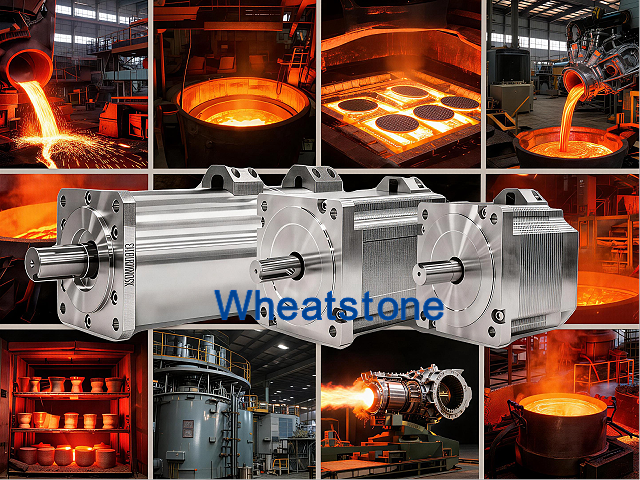
Addressing the three challenges of thermal radiation, frequent thermal cycling, and cleanroom environments in MEA hot pressing applications, Jiangsu Wheatstone has developed a customised high-temperature servo motor series built around four core technologies.
(1) Class H Insulation System with VPI Processing – The First Line of Defence Against Thermal Ageing
Wheatstone high-temperature servo motors are equipped as standard with a Class H (180℃) insulation system (per IEC 60085). The stator winding uses polyimide enamel-coated magnet wire; slot insulation employs a multi-layer composite of polyimide film, glass fabric, and Nomex paper; lead wires use silicone rubber or glass-fibre braided insulation (rated ≥180℃).
The entire winding assembly undergoes vacuum pressure impregnation (VPI): air and moisture are first evacuated from inter-turn and ground insulation voids under vacuum, followed by pressure injection of solvent-free high-temperature impregnating resin to ensure complete void-free filling. VPI-processed windings are less susceptible to micro-crack formation under high-temperature thermal cycling, with significantly enhanced dielectric strength and thermal life.
(2) Wide-Temperature Lubrication System with Cleanroom Compatibility – No Volatilisation at High Temperature, No Solidification at Low Temperature
Wheatstone high-temperature motors are lubricated with polyurea or lithium complex synthetic grease, rated for continuous operation from -40℃ to 180℃. Formulated with synthetic base oils, the grease exhibits extended oxidative induction periods at elevated temperatures, resists carbon deposit formation, and produces minimal volatiles – meeting the air cleanliness requirements of cleanroom environments.
The bearing cavity incorporates fluorocarbon rubber (FKM) seals that maintain elasticity under prolonged exposure to high-temperature hot air, preventing grease leakage after thermal softening and eliminating the risk of grease contamination in cleanroom environments.
(3) High-Temperature Seals and Fully High-Temperature-Rated Components – Eliminating Every Thermal Weak Point
The motor rear cover houses high-temperature-rated circuit boards; encoders are selected from industrial-grade wide-temperature components (operating temperature up to 120℃+); terminal blocks are manufactured from high-temperature engineering plastics (PET, PPS grades); shaft extension seals are fluorocarbon rubber, resisting thermal ageing and compression set. Every component is re-specified for high-temperature operation, preventing the “weakest link” effect from causing premature motor failure.
(4) Ex db IIB T4 Gb Flameproof Certification – A Safety Barrier for Hydrogen Environments
MEA hot pressing workshops involve flammable gas environments such as hydrogen. Wheatstone high-temperature servo motors are optionally available with Ex db IIB T4 Gb flameproof certification – the flameproof enclosure withstands internal explosion pressure and prevents flame propagation to the external atmosphere; Temperature Class T4 ensures the maximum surface temperature does not exceed 135℃, providing reliable safety protection for hydrogen production environments.
From “Adequate” to “Optimal”: The Value of WheatstoneCustomisation Services
As MEA hot presses are critical equipment in the hydrogen energy industry supply chain, different equipment manufacturers have varying design conventions for motor mounting dimensions, interface flanges, encoder types, and wiring configurations. Drawing on specialised experience in custom motor design, Wheatstone offers comprehensive customisation for hot press applications:
Mounting dimension customisation: Co-design with hot press manufacturers to match flange interfaces and shaft dimensions for seamless replacement or new equipment integration
Encoder customisation: Resolver, incremental encoder, or high-resolution absolute encoder, configurable to match control system feedback protocols
Cable interface customisation: Stainless steel cable glands or aviation connectors for seamless integration with hot press electrical junction boxes
Insulation class upgrade: Class C (>200℃) insulation systems available for extreme applications with hot plate temperatures exceeding 200℃
Wheatstone High-Temperature Ex Motor – Technical Specifications (MEA Hot Press Configuration)
| Parameter | Wheatstone High-Temperature Ex Motor Specification |
| Insulation class | Class H (180℃) with VPI processing |
| Ambient temperature range | -20℃ to +60℃ (standard); -40℃ to +100℃ (customisable extended) |
| Bearing grease | Polyurea/lithium complex synthetic grease (-40℃ to 180℃), low volatilisation, cleanroom compatible |
| Seal material | FKM O-rings (static), high-temperature FKM lip seals (dynamic) |
| Encoder configuration | Industrial wide-temperature encoder / resolver / high-resolution absolute encoder (customisable) |
| Explosion protection (optional) | Ex db IIB T4 Gb |
| Ingress protection | IP54 / IP55 / IP65 (selected per mounting location) |
| Applicable standards | GB/T 755, IEC 60034-1, IEC 60085, GB 3836 series |
From the micron-thick MEA “sandwich” hot-pressing process to the mass production of fuel cells – inside every precision hot press power unit, Wheatstone high-temperature ex motors are supporting every step of the hydrogen energy industry’s transition from “laboratory” to “production line” with Class H insulation thermal endurance and micron-level precision.
Applicable Standards Reference
| Standard | Scope |
| IEC 60034-1:2022 | Rotating electrical machines – Part 1: Rating and performance |
| IEC 60085 | Electrical insulation – Thermal evaluation and designation – Defines thermal classes including Class H (180℃) |
| IEC 60079-0 | Explosive atmospheres – Part 0: Equipment – General requirements |
| IEC 60079-1 | Explosive atmospheres – Part 1: Equipment protection by flameproof enclosures “d” |
| GB 3836.1 | Explosive atmospheres – Part 1: Equipment – General requirements (China, equivalent to IEC 60079-0) |
| GB 3836.2 | Explosive atmospheres – Part 2: Equipment protection by flameproof enclosures “d” (China, equivalent to IEC 60079-1) |
| GB/T 755 | Rotating electrical machines – Rating and performance (equivalent to IEC 60034-1) |
About Wheatstone
With more than 20 years of specialised experience in special-purpose motors, Wheatstone offers a comprehensive portfolio including high-temperature ex motors, flameproof servo motors, deep-sea motors, and axial flux motors. The company is ISO 9001 and IATF 16949 certified, holding China CCCEx flameproof, coal mine MA, IECEx, and EU ATEX explosion protection certifications.
For customised high-temperature ex motor solutions for fuel cell MEA hot press applications, please contact the Wheatstone technical team.

 86-0519-86163211,86-0519-86163212







