The short answer: anywhere from $500 to $50,000. The long answer: you‘re asking the wrong question.
If you’ve ever searched for “ATEX motor price,” you already know the frustration. One supplier quotes $1,200. Another says $8,000. A third won‘t even give you a number without a signed NDA and a 45-minute discovery call.
You’re not alone. This is the most common question we hear from procurement managers, plant engineers, and EPC contractors — and it‘s also the most misleading one.
The price of an ATEX motor is not a number. It’s a calculation.
Here‘s what actually determines the cost — and why the cheapest quote is almost never the right answer.
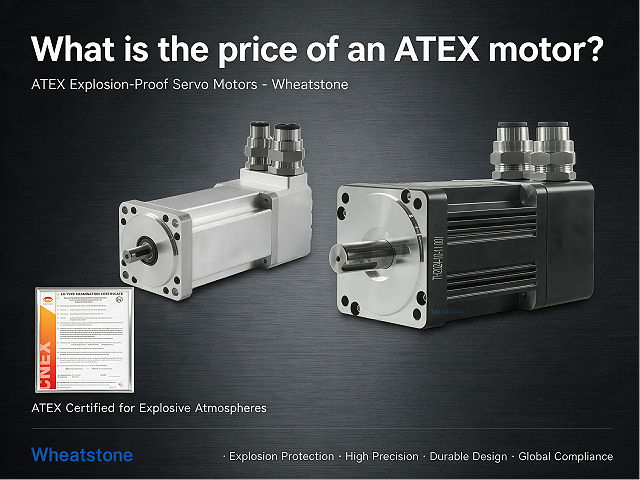
What you’re really paying for
The enclosure: it‘s not just “heavier” — it’s engineered to contain an explosion
An ATEX motor isn‘t a standard motor with a “flameproof” sticker. The housing alone can account for 20-40% of the total cost-.
Ex d (flameproof) enclosures require significantly thicker walls to withstand internal explosion pressure-. The flameproof joints must be machined to micron-level tolerances — surface roughness Ra ≤ 6.3μm, gap widths strictly controlled per IEC 60079-1-. Every single mating surface is precision-ground. Every bolt hole is torque-specified. Every cable entry is sealed with an explosion-proof gland.
That‘s not “heavy-duty.” That’s precision engineering with zero room for error.
Certification: the hidden cost that never goes away
ATEX and IECEx certification isn‘t a one-time fee. It’s a continuous investment-.
Certification fees can add 10-25% to the ex-factory price-. Type testing alone runs from several thousand to tens of thousands of euros-. Notified Body involvement for high-risk equipment can cost anywhere from €2,000 to €10,000+-. And that‘s before you factor in the engineering hours for documentation, compliance files, and ongoing surveillance audits.
For IIC (hydrogen, acetylene) and T4/T6 temperature classes, the testing is even more rigorous-. Every batch, every design change, every supplier material substitution — all subject to re-verification.
Materials: you get what you pay for
Housing: high-grade cast iron or 316L stainless steel — not mild steel with paint
Magnets: samarium-cobalt (SmCo) for high-temperature and radiation environments — not cheap ferrite-
Insulation: Class H (180℃) polyimide or mica tape — not standard polyester
Seals: fluorocarbon (FKM/Viton) for -40°C to +200°C — not standard nitrile
Efficiency: the 97% rule that changes everything
Here‘s a number that surprises most buyers: the purchase price of an industrial motor accounts for only about 2% of its lifetime cost-.
Purchase price: ~2%
Maintenance: ~1%
Energy: ~97%
An IE5 or IE6 ATEX motor can reduce energy losses by 40-60% compared to an IE3 motor-. Over a 20-year service life, that‘s €87,520 in energy savings for a single 110kW motor-. The premium you pay today comes back many times over.
Application: Zone 0, 1, or 2? The price triples — for good reason
| Zone | Risk Level | Typical Price Range (50 HP) |
| Zone 2 (Ex nA) | Low | $2,000 - $4,500 |
| Zone 1 (Ex d/Ex e) | High | $5,000 - $12,000 |
| Zone 0 (Ex ia) | Highest | $12,000 - $25,000 |
Zone 0 motors require intrinsic safety — the most demanding and expensive protection method-. Zone 1 needs flameproof or increased safety enclosures-. Zone 2 allows non-sparking designs, which are significantly more cost-effective-.
Customisation: standard vs. built-for-you
Standard frame sizes: lower cost, faster delivery
Custom shafts, flanges, or mounting: engineering + setup fees
Special coatings (C5-M marine, chemical-resistant): material + application
Dual brakes, custom encoders, special connectors: each adds cost — and value
The real question isn’t “how much” — it‘s “how much is it costing you to NOT have the right motor?”
Consider what’s at stake:
One motor failure in a Zone 1 area → production stop → €50,000 – €500,000 per hour in lost revenue
One non-compliant motor → regulatory fine → €100,000+
One inefficient motor → 5% higher energy consumption → €10,000+ per year, every year
The cheapest ATEX motor isn‘t the one with the lowest sticker price. It’s the one that doesn‘t fail, doesn’t get you fined, and doesn‘t waste energy for the next 20 years.
When does an ATEX motor actually make financial sense?
| Scenario | Cost of Wrong Motor | Value of Right Motor |
| Oil & gas wellhead | €20,000/hour downtime | €50,000 premium is recovered in 2.5 hours |
| Chemical reactor agitator | €15,000/hour + safety risk | €30,000 premium is recovered in 2 hours |
| Pharmaceutical filling | €50,000/batch scrap | €10,000 premium is recovered in 1 batch |
| Offshore platform crane | €100,000/day downtime + logistics | €40,000 premium is recovered in 0.4 days |
So, what is the price of an ATEX motor?
A 50 HP Ex d IIB T4 Gb motor typically runs $5,000 – $12,000-.
But that‘s just the starting point. The real cost is the total cost of ownership — and that’s where the difference between a good motor and a great motor becomes painfully clear.
The formula:
ATEX Motor Price = (Enclosure + Certification + Materials + Efficiency + Zone Classification + Customisation) × your risk tolerance
The bottom line:
WHEATSTONE doesn‘t sell the cheapest ATEX motors. We sell the ones that keep your plant running, your people safe, and your energy bills low — year after year.
If you want a cheap motor, we’re not your supplier. There are plenty of those.
If you want a motor that‘s been tested, certified, and built to survive the harshest hazardous environments — with verified test data, traceable certifications, and a team that actually answers the phone when you call — then let’s talk.
Ready to stop guessing?
Send us your application details: Zone classification (1, 2, 21, 22), gas group (IIA, IIB, IIC), temperature class (T1-T6), power requirements, and mounting constraints.
We‘ll send you a detailed quote within 48 hours — with full certification breakdown, efficiency analysis, and total cost of ownership calculation.
No surprises. No hidden fees. Just the right motor for your hazardous area.
Contact WHEATSTONE today. Your plant — and your bottom line — will thank you.
About WHEATSTONE
With more than 20 years of specialised experience in explosion-proof and special-purpose motors, WHEATSTONE offers a comprehensive portfolio including ATEX/IECEx certified flameproof servo motors, explosion-proof stepper motors, high-temperature motors, and subsea motors. The company is ISO 9001 and IATF 16949 certified, holding IECEx, ATEX, and multiple international explosion protection certifications. Custom solutions available from 50W to 200kW, with frame sizes from 40mm to 400mm.

 86-0519-86163211,86-0519-86163212







