Every Kilogram on an Offshore Platform Costs Money – How Wheatstone Motors Help Cranes Go on a Diet
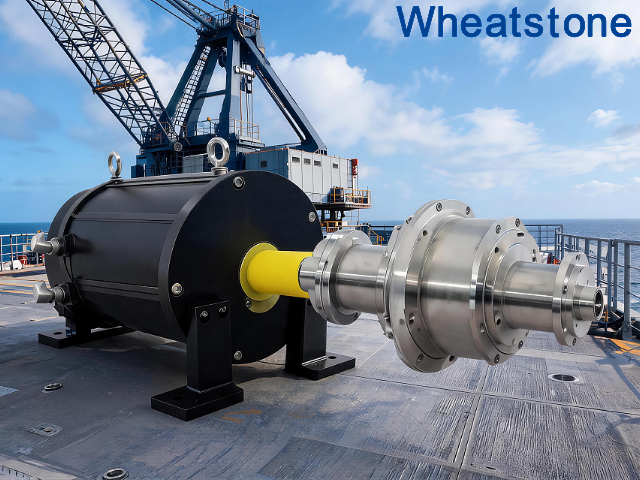
On a drilling platform in Bohai Bay, a pedestal-mounted crane is lifting drilling equipment. The boom winch is equipped with two IEC 315 frame motors, each weighing 1.7 tonnes-. And there is more than one such motor on the platform – hoisting, luffing, and slewing mechanisms each require one or more motors.
Offshore platforms are the epitome of "space is money." Deck area is limited, and every additional kilogram of equipment weight adds cost to platform structural design. More critically, total platform weight directly affects float-over installation difficulty and safety. On offshore platforms, space is a scarce resource, imposing stringent requirements on equipment volume and weight-.
The Four Hard Constraints on Offshore Platform Crane Motors
Constraint 1: Weight – Every Kilogram Saved Is Real Money
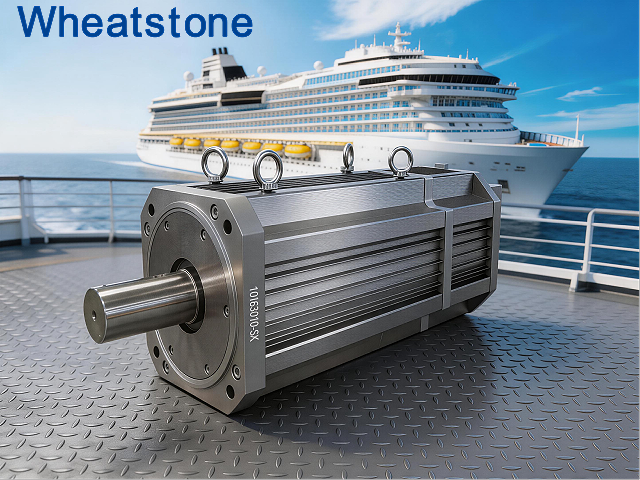
Platform crane motors are typically installed in boom winches, slewing mechanisms, or luffing mechanisms. A conventional radial flux motor can weigh hundreds of kilograms or even several tonnes. On a platform, this weight consumes deck area and structural capacity while also affecting platform stability and tow-out safety.
Constraint 2: Volume – Compactness Is Non-Negotiable
Installation space for platform cranes is extremely limited. Boom roots, tower interiors, and winch compartments – every installation position is the result of careful space allocation. Conventional cylindrical motors have long axial lengths, making them difficult to accommodate in compact crane structures. Every centimetre of motor length saved could free up valuable space for other equipment.
Constraint 3: Corrosion – Salt Spray Is the Motor's "Chronic Poison"
Chloride ion concentrations in the marine atmosphere are tens of times higher than inland. Standard motor housings in such environments rapidly suffer coating peeling, pitting perforation, and fastener seizure. A motor that runs for ten years on land may fail within three years on an offshore platform.
Constraint 4: Explosion Protection – Safety Is the Red Line
Offshore platforms are classified as hazardous areas, where flammable gas or vapour may form explosive mixtures with air-. Crane motors must hold the appropriate explosion protection certification to ensure that internal faults do not ignite the external explosive atmosphere-.
The Three Pain Points of Conventional Motors on Offshore Platform Cranes
Pain Point 1: Excessive Weight, Burdening Platform Payload
Conventional radial flux motors have cylindrical form factors with limited power density. To achieve the torque and power required by platform cranes, motor volume and weight inevitably increase. In crane hoisting mechanisms, motor weight translates directly into structural loads on the boom and tower, driving up the entire crane's structural weight.
Pain Point 2: Bulky Dimensions, Encroaching on Limited Space
The axial length of conventional motors cannot be compressed. In crane winch compartments, motors, gearboxes, brakes, and drums must be arranged compactly. Longer motors require larger winch compartments, directly encroaching on other functional areas of the platform deck.
Pain Point 3: Corrosion and Explosion Protection as Separate “Silos”
Corrosion-resistant motors and explosion-proof motors on the market are often separate product lines. Customers frequently face the dilemma of "corrosion resistance without explosion protection, or explosion protection without corrosion resistance." Even when both are available, they are typically "standard" combinations that cannot be optimised for the specific conditions of platform cranes.
Wheatstone Custom Motors: Tailored Weight Reduction for Offshore Platform Cranes
Jiangsu Wheatstone, with more than 20 years of specialised experience in special-purpose motors, offers customised motor solutions for offshore platform cranes across three dimensions: lightweighting, compactness, and integrated corrosion and explosion protection.
Lightweight Design – Every Kilogram Generates Value
Wheatstone employs axial flux motor technology, delivering approximately 50% reduction in both volume and weight at equivalent power compared to conventional radial flux motors. Axial length can be reduced to one-third that of traditional motors. In platform crane winch drives, this means weight savings of hundreds of kilograms per motor. For a typical platform crane, combined weight reduction across hoisting, luffing, and slewing mechanisms can exceed one tonne.
Compact Structure – Extracting More Possibilities from Limited Space
The flat disc design of Wheatstone axial flux motors allows flush mounting against installation surfaces without consuming additional axial space. This advantage is particularly significant in confined installation positions such as crane winch compartments and tower interiors. Flange dimensions, shaft extension configurations, and mounting orientations are all customisable to achieve seamless integration with existing crane structures.
Integrated Corrosion and Explosion Protection – The Offshore "Safety Armour"
Wheatstone motors feature 316L stainless steel housings, with molybdenum content providing twice the pitting resistance of 304 stainless steel. All fasteners are A4-80 stainless steel. Heavy-duty anti-corrosion coating can be applied to the housing surface, achieving ISO 12944 C5-M (Marine – high salinity), the highest corrosion category. The motors simultaneously hold Ex db IIB T4 Gb flameproof certification and Ex tb IIIC T130℃ Db dust ignition protection certification – delivering true integrated corrosion and explosion protection.
Full-Cycle Customisation – One Customer, One Solution
Wheatstone provides end-to-end customisation services from electromagnetic design and structural design to prototype manufacturing, tailored to the specific operating conditions of platform cranes. Power range covers 50W to 200kW, voltage covers 24V to 3000V, accommodating drive requirements for cranes of different tonnages.
Applicable Standards Reference
| Standard | Scope |
| IEC 60034-1 | Rotating electrical machines – Part 1: Rating and performance – Defines duty types including S4 for crane duty- |
| IEC 60034-6 | Rotating electrical machines – Part 6: Methods of cooling (IC Code)- |
| IEC 60072-2 | Dimensions and output series for rotating electrical machines – Frame numbers and fixing dimensions- |
| EN 13852-1 | Cranes – Offshore cranes – Part 1: General-purpose offshore cranes- |
| NORSOK R002 | Lifting equipment – Offshore crane standard- |
| API 541 | Form-wound squirrel-cage induction motors – 250 HP and larger- |
| ISO 12944 | Paints and varnishes – Corrosion protection of steel structures by protective paint systems – C5-M is the highest corrosion category for marine high-salinity environments |
| IEC 60529 | Degrees of protection provided by enclosures (IP Code) |
| IEC 60079-0 / -1 | Explosive atmospheres – General requirements / Equipment protection by flameproof enclosures "d" |
When a pedestal-mounted crane on an offshore platform lifts drilling equipment in a salt-spray-laden environment; when the winch motor delivers sustained torque in a confined compartment; when platform designers calculate every kilogram of weight – inside every platform crane's power system, Wheatstone custom motors are supporting offshore operations with lightweight design and integrated corrosion and explosion protection.
About Wheatstone
With more than 20 years of specialised experience in special-purpose motors, Wheatstone offers a comprehensive portfolio including axial flux motors, flameproof servo motors, deep-sea motors, and high-temperature motors. The company is ISO9001 and IATF 16949 certified, holding IECEx, ATEX, and other international explosion protection certifications, with custom motor solutions available from 50W to 200kW for offshore platform cranes, marine cranes, and other demanding applications.
For customised motor solutions for offshore platform crane applications, please contact the Wheatstone technical team.

 86-0519-86163211,86-0519-86163212







