Pumps, Pipes, Heat Exchangers, Valves, Controls — An Indirect Liquid Cooling System Adds Dozens of Failure Points. Wheatstone Takes a Simpler Approach to Subsea Motor Thermal Management
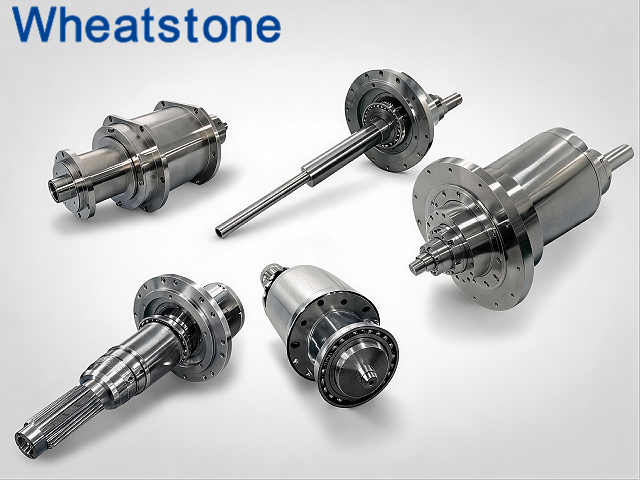
In subsea motor design, thermal management is a severely underestimated challenge.
High-power subsea motors generate substantial heat during operation. Taking a 580 kW submersible motor as an example, the superposition of stator and rotor iron losses, copper losses, and oil friction losses must be controlled — otherwise, temperature rise directly impacts motor service life and reliability. During low-voltage, low-speed, high-torque operation, propulsion motors for underwater vehicles experience high stator winding currents and severe heating, with heat difficult to dissipate due to spatial constraints.
To address this, conventional solutions equip high-power subsea motors with independent cooling systems to achieve forced cooling-. These systems typically include: cooling pumps, cooling pipes, heat exchangers, valves, reservoirs, temperature sensors, flow sensors, controllers, electrical connections — each component a potential failure point.
Indirect Liquid Cooling: The More Complex It Is, The More Fragile It Becomes
Indirect liquid cooling isolates the liquid from the heat source through a metallic intermediary, with heat conducted through solids to the liquid and then expelled-. This approach works well on land. In the deep sea, the problems become apparent.
Failure Point 1: The Cooling Pump — A Rotating Component Reliability Bottleneck
Indirect liquid cooling systems rely on cooling pumps to drive coolant circulation. The pump itself is a rotating machine containing bearings, impellers, seals, and other wear-prone components. In the deep-sea high-pressure environment, the pump‘s mechanical seals face the same dynamic sealing challenges as the main motor. If the pump fails, the entire cooling system is paralysed and motor temperatures run out of control.
Failure Point 2: Pipes and Fittings — Leakage “Time Bombs”
Coolant absorbs heat inside the motor and is pumped to housing heat exchangers in contact with seawater-. This requires the coolant to circulate between the motor interior and external heat exchangers. The longer the piping and the more fittings, the greater the leakage risk. Under deep-sea high pressure, any loose fitting or aged seal can cause coolant leakage — either coolant leaking into the motor interior causing insulation failure, or seawater侵入 the cooling system contaminating the coolant.
Failure Point 3: Heat Exchangers — The Dual Threat of Corrosion and Fouling
Housing heat exchangers in contact with seawater are permanently immersed in highly corrosive seawater. Chloride pitting, marine biofouling, and sediment erosion — heat exchanger performance degrades continuously over time. As heat exchange efficiency declines, cooling system capacity diminishes, motor temperatures gradually rise, and a vicious cycle sets in.
Failure Point 4: Electrical Control Systems — The Deep Sea‘s “Fragile Nerves”
Indirect liquid cooling systems require temperature sensors to monitor motor temperature, flow sensors to monitor coolant flow, and controllers to regulate pump speed. Every one of these electrical components is a potential failure point in the deep-sea high-pressure environment. Sensor drift, controller faults, communication interruptions — any failure in the chain renders the cooling system inoperative.
Failure Point 5: Added Weight — Reduced Payload Capacity
Adding an external cooling system increases the complexity of the motor drive system, reducing equipment reliability. Simultaneously, underwater equipment must carry additional cooling systems, increasing weight and reducing effective payload capacity.
Wheatstone‘s Approach: Solving Complex Problems with Simpler Solutions
Jiangsu Wheatstone, with more than 20 years of specialised experience in special-purpose motors, offers multiple solutions for high-power subsea motor thermal management that are simpler and more reliable than indirect liquid cooling.
Solution 1: Oil Bath Natural Convection Cooling — No Pump, No Piping
Wheatstone deep-sea motors employ oil-filled construction, with the motor interior filled with insulating oil. During operation, rotor rotation drives natural convection of the internal oil, transferring heat from windings and core to the housing, which then exchanges heat with seawater-. No cooling pump, no external piping, no heat exchanger — minimum failure points.
Solution 2: Pressure-Compensated Oil-Filled Structure — Balancing Internal and External Pressure
For ultra-deep-water conditions, Wheatstone employs a pressure-compensated oil-filled structure — the motor interior is filled with insulating oil, with a compensation membrane balancing internal oil pressure with external water pressure. The pressure differential across the motor approaches zero. The oil serves dual purposes: as both an insulating medium and a cooling medium.
Solution 3: Direct Housing Water Cooling — Leveraging the Deep-Sea Low-Temperature Environment
Deep-sea water temperatures are low (0℃), providing a natural high-quality cooling source. Wheatstone optimises housing heat dissipation structure design to enable direct heat exchange between the housing and seawater. Natural cooling not only greatly reduces steady-state temperature rise but can also increase output torque by approximately 10% at thermal steady state-. No intermediate heat exchange medium — shortest thermal resistance path.
Solution 4: Adaptive Cooling Structures — Utilising the Motor‘s Own Rotational Power
Drawing on cutting-edge adaptive cooling concepts, Wheatstone can integrate impeller structures on the motor rotor shaft, using the rotor’s own rotational power to drive internal cooling medium circulation. No additional pump, heat exchanger, cooling oil, or electrical control required — overall structure is simpler.
Solution 5: Full-Cycle Simulation Validation — Calculating Heat Flow at the Design Stage
Wheatstone integrates electromagnetic-thermal-fluid coupled simulation into the development process, establishing temperature field calculation models based on operating conditions, achieving fluid-structure interaction automatic heat transfer, and simulating the flow of internal and external cooling media. Transforming thermal design from experience-based trial and error into quantifiable and verifiable engineering metrics.
Applicable Standards Reference
| Standard | Scope |
| IEC 0034:2022 | Rotating electrical machines – Part 1: Rating and performance |
| IEC 0034- | Rotating electrical machines – Part : Methods of cooling (IC Code) |
| API 17F | Subsea production control systems – Design standards for subsea equipment |
| ISO 1328- | Petroleum and natural gas industries – Design and operation of subsea production systems |
When a high-power subsea motor delivers sustained output at 3,000 metres depth; when the cooling system no longer requires pumps, piping, heat exchangers, valves, and complex electrical controls; when effective payload is no longer consumed by additional cooling systems — inside every deep-sea equipment power system, Wheatstone custom subsea motors are solving the most complex thermal challenges with the simplest solutions.
About Wheatstone
With more than 20 years of specialised experience in special-purpose motors, Wheatstone offers a comprehensive portfolio including subsea motors, flameproof servo motors, high-temperature motors, and axial flux motors. The company is ISO 9001 and IATF 1949 certified. The subsea motor series covers four depth ratings: 500m, 3000m, 000m, and 8000m, offering multiple thermal management solutions including oil bath natural convection, pressure-compensated oil filling, direct housing water cooling, and adaptive cooling, with custom solutions available from 50W to 200kW.
For customised subsea motor thermal management consultation and solutions, please contact the Wheatstone technical team.

 86-0519-86163211,86-0519-86163212







