At a marine engineering facility in Zhoushan, Zhejiang, engineers were inspecting a deep-sea motor recently retrieved from the ocean floor. Technician Wu wiped the stator interior with a cotton swab—it came out pristine white. He exhaled and turned to his apprentice: "See that? Two years submerged, not a drop inside. That's real craftsmanship."
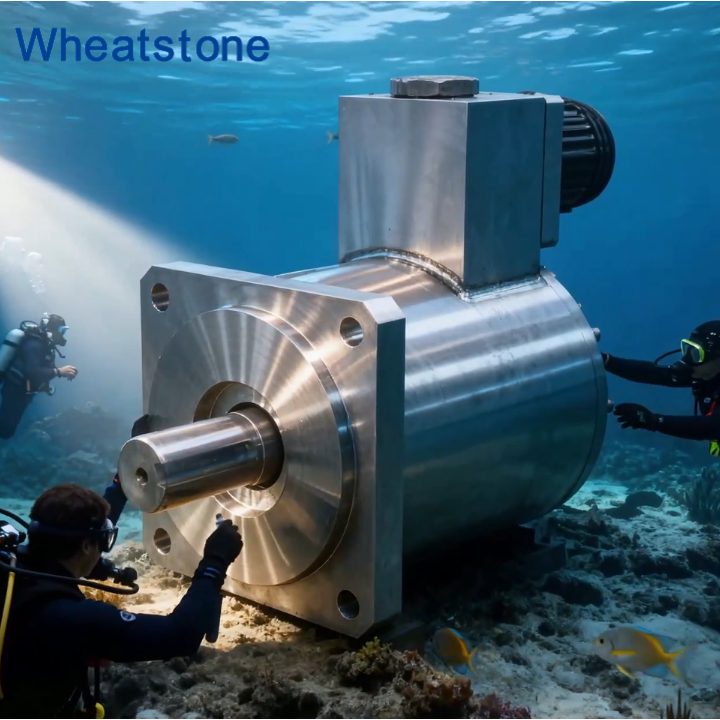
That motor was delivered by Wheatstone two years ago, powering a thruster on an ocean observation network, sitting 50 meters deep through typhoon-driven currents and winter waters below freezing. The inspection results impressed everyone: winding insulation resistance above 500MΩ, bearing grease still fresh, seals still supple.
Wu has seen too many motors fail underwater. Some shorted within a week. Others leaked through aged seals. Some corroded into pitted messes. He says: "Taking a motor underwater looks simple, but the engineering beneath is deep."
I. First Barrier: IP68 Is Just the Start
Many assume an underwater motor just needs IP68 rating. But IP68 only means it can survive lab conditions. Real deep-sea environments combine high pressure, low temperature, corrosion, and cyclic stress.
The Wheatstone engineering team has a saying: IP68 is the entrance exam. The real test begins at 100 meters, 500 meters, 1000 meters.
In Wheatstone's workshop, every deep-sea motor passes three sealing barriers:
Static seals use aviation-grade fluoroelastomer O-rings rated from -40°C to +200°C, with compression set below 15%—they don't "relax" under deep-sea pressure. Housing joints are coated with specialty sealant that cures strong enough to withstand 20MPa.
Dynamic seals are the true challenge. The shaft rotates, but water must stay out. Wheatstone uses double-face mechanical seals with silicon carbide faces—hardness second only to diamond. A micron-thick fluid film separates the faces, lubricating while sealing. Add a sand-slinging ring, and even suspended sediment stays out.
Terminal seals use glass-sintered feedthroughs. Not Ordinary waterproof connectors—these fuse metal pins with specialty glass at the atomic level. Not even helium leaks through. This technology originated in nuclear submarines; Wheatstone adapted it for commercial deep-sea motors.
Wu later remarked: "Those terminals look like ceramic, feel like glass. Connect the cable, tighten down, and you could leave them on the seafloor for a decade."
II. Material Barrier: Seawater Is "Metal Acid"
How corrosive is seawater? Chloride concentration thousands of times higher than freshwater, corroding mild steel 8 times faster than on land. Wheatstone deep-sea motor housings use 316L stainless steel with higher molybdenum content, pitting resistance double that of 304. All fasteners are A4-80 stainless steel—strong, corrosion-proof.
For extreme needs, Wheatstone offers titanium alloy options. Titanium forms a dense oxide film in seawater, virtually immune to corrosion. One deep-sea research project used titanium-housed motors—after five years, surfaces looked brand new.
Shaft extensions are corrosion hotspots. Wheatstone sprays ceramic coatings: grit-blast the surface, plasma-spray alumina ceramic to "weld" a 0.3mm layer with HRC70+ hardness, corrosion-proof and wear-resistant.
III. Electrical Barrier: Insulation Is the Motor's "Lifeline"
Underwater, insulation failure is fatal. Standard motors use Class B or F insulation—insulating varnish absorbs water, resistance plummets.
Wheatstone deep-sea motors use Class H insulation (180°C) with polyimide film and mica tape composites. Polyimide film maintains electrical properties from liquid helium temperature (-269°C) to 300°C. Mica tape resists corona and aging.
The process is Vacuum Pressure Impregnation. The stator goes into a vacuum chamber, evacuated to 10⁻¹Pa to extract air and moisture from windings, then specialty solvent-free varnish is injected under pressure, filling every void. Finally, rotating oven curing ensures uniform thickness, zero bubbles.
Wheatstone's test standard is "underwater withstand voltage." Every motor is submerged in 3% salt water, subjected to 1.5x rated voltage for 24 hours—insulation resistance must stay above 100MΩ to pass.
IV. Protection Barrier: Giving Motors an "Early Warning System"
Underwater, you can't see what's happening until it's too late. Wheatstone deep-sea motors embed a full protection system:
Winding temperature: PT100 sensors in each phase, real-time data上传, automatic load reduction or alarm at setpoints.
Bearing temperature: Thermocouples monitoring lubrication health.
Water ingress detection: Leak sensors in motor cavity, oil chamber, and junction box—any moisture triggers alarm or shutdown.
Insulation monitoring: Real-time resistance tracking, heat-conducting before breakdown.
Dehumidification: Internal heaters maintain cavity temperature 5°C above dew point during shutdown, preventing condensation .
These sensors connect via CAN bus or Ethernet, allowing remote monitoring from hundreds of kilometers away. An offshore wind farm operator said: "We used to repair after failure. Now sensors tell us when to repair—that's preventive maintenance."
V. Thermal Barrier: Staying "Cool" Underwater
Water is the cooling medium—advantage and challenge. Wheatstone deep-sea motor housings feature helical cooling fins, maximizing surface area as water flows past.
For higher power, composite cooling combines water and oil. Stator back has cooling water jacket; rotor cavity fills with heat-conducting oil circulating through hollow shaft, carrying heat to end bells where water carries it away.
A deep-sea ROV project used Wheatstone's 25kW oil-filled servo motor, rated torque 165Nm, peak 330Nm, operating at 850 meters depth for 2000 hours with winding temperatures below 80°C.
VI. Wheatstone Deep-Sea Motor Selection Range
| Series | Depth Rating | Power Range | Cooling | Protection | Typical Applications |
| WD Series | ≤100m | 0.75-22kW | Natural | IP68 | Shallow propulsion, underwater cleaning |
| WDH Series | ≤500m | 1.5-55kW | Water-cooled | IP68 + pressure compensation | ROVs, underwater manipulators |
| WDU Series | ≤1000m | 7.5-132kW | Water + oil | Fully sealed, pressure-balanced | Deep-sea mining vehicles,海底 observatories |
| Custom Series | Custom | Custom | Custom | Custom | Special applications |
Final Thoughts
After completing his inspection report, Wu added a note: "This motor spent two years underwater and came out cleaner than some motors on dry land."
Wheatstone has spent over a decade accumulated hard-won experience in deep-sea motors. Materials, processes, sealing, insulation, protection, cooling—every detail sharpened by real projects. Someone asked: Why do Wheatstone motors survive underwater when others don't? The answer isn't in any single feature—it's in every single feature.
If you're looking for motors that can go underwater—100 meters or 1000, freshwater or salt—let's talk. Wheatstone's engineering manual contains dozens of sealing solutions and hundreds of material combinations. Maybe the perfect one is waiting for your project.
Contact Jiangsu Wheatstone: .wheatstonemotor.com. Ask for an engineer directly. We're happy to talk through the details.

 86-0519-86163211,86-0519-86163212







