Imagine performing a pirouette next to a chemical reactor—the floor slick with oil, the air heavy with xylene vapor. Every spin could ignite the atmosphere. That's the situation a standard motor faces in a hazardous area. It's not that it's a bad motor; it's that it's in the wrong place.
The explosion-proof servo motor is the precision dancer wearing a gas mask. It executes complex, demanding moves with pinpoint accuracy (the "servo" part) while ensuring that no matter what happens internally, it never ignites the surrounding environment (the "explosion-proof" part). This isn't simply stuffing a motor into a thick housing—it's a systematic engineering feat spanning materials, electromagnetic design, and thermal dynamics.
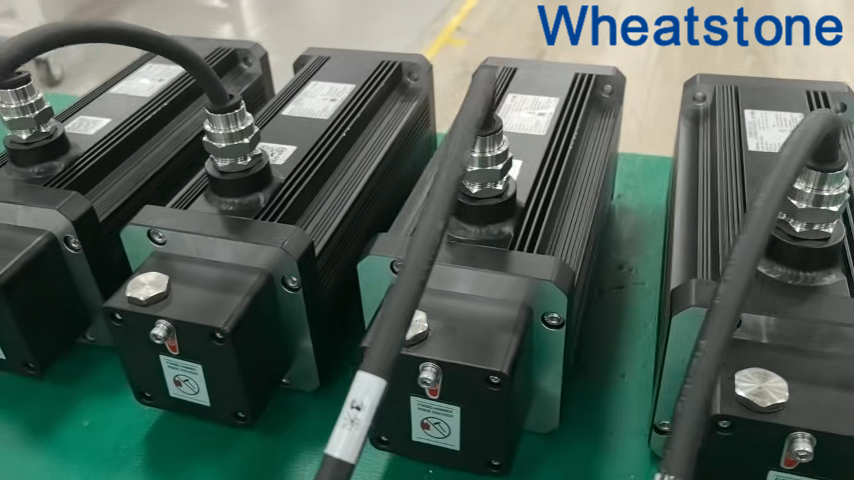
I. The Essence of Explosion Protection: It's Not About "Not Exploding," It's About "Containing the Unavoidable"
A common misconception is that an explosion-proof motor is "indestructible." That's like saying body armor makes you bulletproof. The core principle is different: even if the worst happens inside—a winding short circuit, arcing, or bearing overheating—the motor will never transmit that hazard to the outside.
This rests on two pillars: flameproof containment and energy limitation.
Flameproof Enclosure (Ex d) : The motor wears armor. This armor isn't meant to block the blast but to use precision-machined flame paths to cool escaping hot gases below the ignition temperature of the external atmosphere. Wheatstone's explosion-proof servo motors control flame path surface roughness to Ra≤6.3μm and joint lengths ≥25mm, ensuring that any internal explosion—tested at 1.5× rated pressure—is quenched before reaching the outside.
Increased Safety (Ex e) : This approach eliminates the chance of sparks altogether. Under normal operation, the motor simply doesn't produce sparks, arcs, or dangerous temperatures. Wheatstone achieves this with Class H insulation (180℃) and Vacuum Pressure Impregnation (VPI) —essentially letting the windings soak in a solvent-free resin bath that fills every microscopic void, eliminating potential partial discharge paths. In a chemical plant reactor agitator application, this process kept winding temperatures consistently 35℃ below the Class H limit.
II. The Soul of Servo: Turning Brute Force into Refined Control
If explosion protection is a motor's "safety baseline," then servo control is its "IQ ceiling."
A standard induction motor is like a weightlifter—strong but lacking finesse. A servo motor is like a gymnast—every move is measured to the millisecond and millimeter. This precision comes from three core components:
High-Resolution Encoder: The motor's "eye." While a standard motor guesses its rotor position, a servo motor sees it. Wheatstone's 23-bit absolute encoder resolves over 8 million positions per revolution—equivalent to pinpointing a single grain of sand on a football field.
Closed-Loop Control Algorithm: The motor's "brain." The drive constantly reads the encoder's feedback, adjusting current in real-time so the motor goes exactly where it's told. On a lithium-ion battery coating line in Germany, a Wheatstone explosion-proof servo motor maintained speed fluctuation below ±0.1%, enabling coating thickness uniformity of 99.5%.
Low-Inertia Rotor: The motor's "reaction speed." A lighter rotor accelerates and decelerates faster. Through optimized rotor design, Wheatstone reduced inertia by 30% without sacrificing torque, trimming a robotic pick-and-place cycle from 0.5 seconds to 0.3 seconds.
III. Explosion-Proof + Servo: Where the Real Engineering Begins
The real challenge starts when these two worlds collide. An explosion-proof housing traps heat, but a servo motor generates plenty of it. This is a fundamental conflict.
Wheatstone's solution is "heat source separation." The hottest components—power devices—are physically isolated from the motor body, and high-thermal-conductivity grease channels their heat to dedicated cooling fins on the housing. On a sterile filling line in a Swiss pharmaceutical plant, this design kept housing temperatures 15℃ cooler than comparable units, running flawlessly for three years in a GMP-classified cleanroom.
Another challenge is sealing. Servo motors need to send high-precision encoder signals out, while explosion-proof regulations demand hermetically sealed terminals. Wheatstone uses glass-sintered terminals—metal pins fused with specialty glass at high temperature, forming an atomic-level bond. Not even helium can leak through. A valve control system on a North Sea platform equipped with these terminals operated for five years in a salt-spray environment; inspection revealed terminals as clean as the day they were installed.
IV. A "Not-Quite-Specific" Example: A Day in the Life of a Wheatstone Explosion-Proof Servo Motor
In a large refinery in Rotterdam, an explosion-proof servo motor has been driving the main fan in a catalytic cracking unit for five years. Its rated torque is 220Nm, with a peak of 450Nm. But what really matters to the engineers isn't these numbers—it's the daily performance:
7:00 AM: Process adjustment. Speed ramps smoothly from 300rpm to 2500rpm. The current waveform is as clean as if drawn with a ruler.
2:00 PM: Grid voltage dips. The motor compensates instantly. The speed needle doesn't twitch.
11:00 PM: A technician touches the housing. Warm, not hot.
This is routine for a Wheatstone explosion-proof servo motor. It doesn't try to show off. It just does its job—quietly, precisely, safely—wherever it's needed.
V. Conclusion: Not a Luxury, But a Necessity
In chemical plants, pharmaceutical facilities, grain processing mills, and paint shops, explosion-proof servo motors aren't a "nice-to-have" upgrade—they're a non-negotiable foundation for safe, efficient production. They use rigorous structural design to lock danger inside, and sophisticated control algorithms to push efficiency to its peak.
For over two decades, Jiangsu Wheatstone has specialized in this intersection of safety and precision. From -196℃ cryogenics to 200℃ high heat, from vacuum chambers to 8,000-meter deep-sea environments, from general industry to nuclear and aerospace applications—every motor carries a simple philosophy: true safety isn't measured by specifications written on paper, but by the stubborn attention to detail forged into every design.

 86-0519-86163211,86-0519-86163212







