In 2025, China's Ministry of Emergency Management issued guidelines for the retirement and replacement of aging chemical facilities, explicitly encouraging automation upgrades to improve inherent safety. Provinces including Shandong, Jiangsu, and Zhejiang have since rolled out policies supporting intelligent retrofits in chemical parks.
Against this backdrop, demand for explosion-proof automation equipment has surged. Yet many field engineers face a frustrating reality: even the most advanced explosion-proof servo motor becomes a maintenance burden when replacement requires hours of wiring, sealing, and testing. When multiple stations are involved, production lines can grind to a halt for days.
This isn't just about efficiency—it's about production continuity.
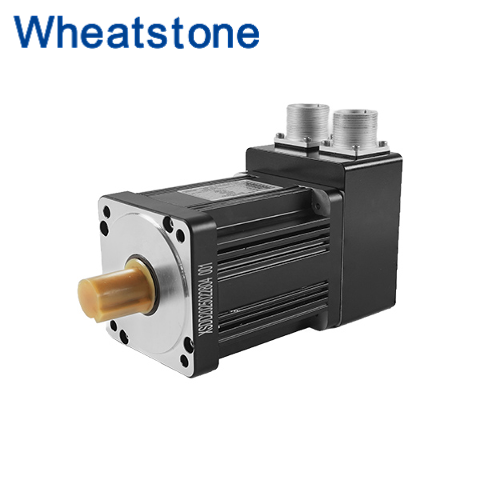
I. What Makes Traditional Explosion-Proof Motor Replacement So Time-Consuming?
Replacing a standard flameproof servo motor in a hazardous area follows a rigid protocol:
Isolate and verify: Safety lockout, tagout, and verification—non-negotiable.
Remove cables: Loosen explosion-proof glands, extract power, encoder, and brake cables—three cables, six sealing points.
Remove motor: Unbolt and lift away the old unit.
Install new motor: Position and secure.
Re-cable and connect: Thread cables back through glands, strip, crimp, and terminate—each connection requiring meticulous care.
Reseal: Tighten glands, apply sealing compound where required.
Commission: Power up, configure communication, tune parameters, test run.
A skilled technician typically needs 3-4 hours for this sequence. When glands are awkwardly positioned or cable access is tight, half a day can easily slip away. Worse, each resealing introduces risk—an improperly tightened gland, a misaligned seal—any of which can compromise safety.
II. The Quick-Connect Solution: From "Wire and Seal" to "Plug and Twist"
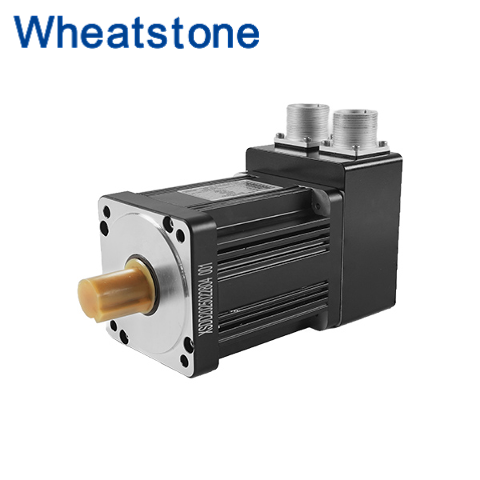
The hazardous-area quick-connect servo motor replaces traditional cable gland entry with a plug-and-socket interface—a simple change with profound engineering implications.
Key Change 1: Pre-Made Cables, No On-Site Termination
Wheatstone's quick-connect motors come with factory-terminated hybrid cables. One end is a sealed plug; the other is pre-stripped and labeled for termination in a safe-area cabinet. On-site, the motor's socket is already fitted. The technician simply aligns the plug, pushes, and twists. A mechanical latch clicks into place, completing both electrical and sealing connections.
Field crews joke: "We used to do surgery; now we plug in a USB drive."
Key Change 2: Integrated Signals, One Cable
Traditional setups require separate cables for power, encoder feedback, and brake control—three cables, three glands, three potential failure points. Wheatstone's quick-connect motors combine all signals into a single hybrid cable. Differential signaling ensures encoder integrity; shielded conductors isolate the brake circuit.
Key Change 3: Sealing by Design, No Extra Steps
When the plug mates with the socket, precision-machined metal faces compress a pre-installed seal. Tightening the locking nut completes the sealing process. No gland torque adjustments, no sealant application—just reliable sealing every time.
III. Real-World Case: From Two Days of Downtime to Two Hours
In 2025, a chemical plant in Jiangsu needed to replace a faulty explosion-proof servo motor on a reactor agitator line. Past experience suggested at least two days of downtime—removing cables, swapping the motor, rewiring, and recommissioning.
This time, they used a Wheatstone quick-connect motor. The sequence:
8:30 AM: Lockout and tagout complete.
8:40 AM: Old motor mounting bolts loosened. Quick-connect plug released.
8:50 AM: Old motor removed; new motor positioned.
9:00 AM: Pre-made hybrid cable plugged in; locking nut tightened.
9:20 AM: Power restored, parameters loaded, test run initiated.
10:00 AM: Line back in production.
From shutdown to restart: less than two hours. The field engineer noted: "We used to move house to change a motor. Now it's like changing a light bulb."
IV. Wheatstone Quick-Connect Motors: Speed with Substance
In hazardous areas, speed matters only if reliability is uncompromised. Wheatstone's design ensures that the "quick" part doesn't sacrifice safety:
Metal-to-Metal Sealing: The plug and socket mate through precision-machined metal surfaces compressing a durable seal. Tested to 1.5MPa water pressure, achieving IP66/IP67 protection.
Keyed Connectors: Different cable specifications use different keying patterns—cables cannot be incorrectly inserted.
Vibration-Resistant Locking: Locking nuts incorporate anti-vibration threads that resist loosening under continuous machine operation.
Full Certification: Wheatstone quick-connect motors hold explosion-proof certificates, CCC certification, and select models are IECEx and ATEX approved for international projects.
V. Conclusion: Let "Motor Replacement" Stop Being an Event
Automation upgrades in hazardous areas aim to improve safety and efficiency. When the replacement process itself becomes the bottleneck, the upgrade loses purpose.
Wheatstone's hazardous-area quick-connect servo motors turn a half-day wiring exercise into a few minutes of plug-and-play. It's not a radical invention—it's the pragmatic solution that engineers have refined through years of on-site experience.
If you're wrestling with the downtime and complexity of motor replacements, take a look at what quick-connect technology has done for others. The time they've saved is more than hours—it's years of maintenance peace of mind.

 86-0519-86163211,86-0519-86163212







