At a large refinery in Shandong, equipment supervisor Zhou was commissioning new automated equipment near the reactor area. Pointing to a motor no larger than a paperback book mounted directly on the equipment frame, he told his apprentice: "A few years ago, this kind of installation would have required a separate explosion-proof cabinet for the drive, plus the motor hanging off the side. Wiring alone took half a day. Now this single unit eliminates half the control cabinet."
What Zhou described is the explosion-proof integrated servo motor—a technology that has rapidly transformed hazardous-area automation over the past few years.
From 2023 to 2026, the market for explosion-proof integrated servo motors in China has grown at an average annual rate exceeding 20%. In automation retrofit projects across fine chemicals, pharmaceuticals, oil and gas, and coating industries, the adoption rate of integrated units has jumped from under 15% to nearly 45%. This isn't just a product evolution—it's a fundamental shift in system architecture and engineering philosophy.
I. The Traditional Separate Solution: Hidden Costs You Don't See
Before integrated units became mainstream, automation engineers were accustomed to the "motor + drive" separate configuration. This architecture is mature and stable in general industrial settings, but in explosion-proof applications, it exposes a series of deep-seated contradictions.
Contradiction 1: Space vs. Protection
Space in hazardous areas is at a premium. Separate systems require a dedicated explosion-proof cabinet for the drive—additional floor space, extra cable trays, more cable glands. In retrofit projects, engineers often face the dilemma of "equipment ready, no space for the cabinet." In one pharmaceutical intermediate plant retrofit, drives had to be installed on two different floors with signal cables running 80 meters, turning noise immunity into a major headache.
Contradiction 2: The Hidden Cost of Wiring
A separate system requires at least three cables between motor and drive: power, encoder, and brake. Each cable must pass through its own explosion-proof gland. A single installation could take half a day. More critically, every gland and every terminal is a potential failure point. Industry data from a petrochemical facility showed that over 30% of field failures in separate explosion-proof servo systems originated from wiring issues.
Contradiction 3: Thermal Management vs. Service Life
Drives sealed inside explosion-proof cabinets struggle to dissipate heat. Every 10℃ rise cuts electrolytic capacitor life in half. A drive that would last 8-10 years in a ventilated cabinet might fail in 5-6 years when sealed in an explosion-proof enclosure.
II. The Integrated Solution: A Systemic Engineering Overhaul
An explosion-proof integrated servo motor isn't just a motor and drive glued together. It represents a complete system-level engineering redesign.
Redesign 1: Heat Source Separation
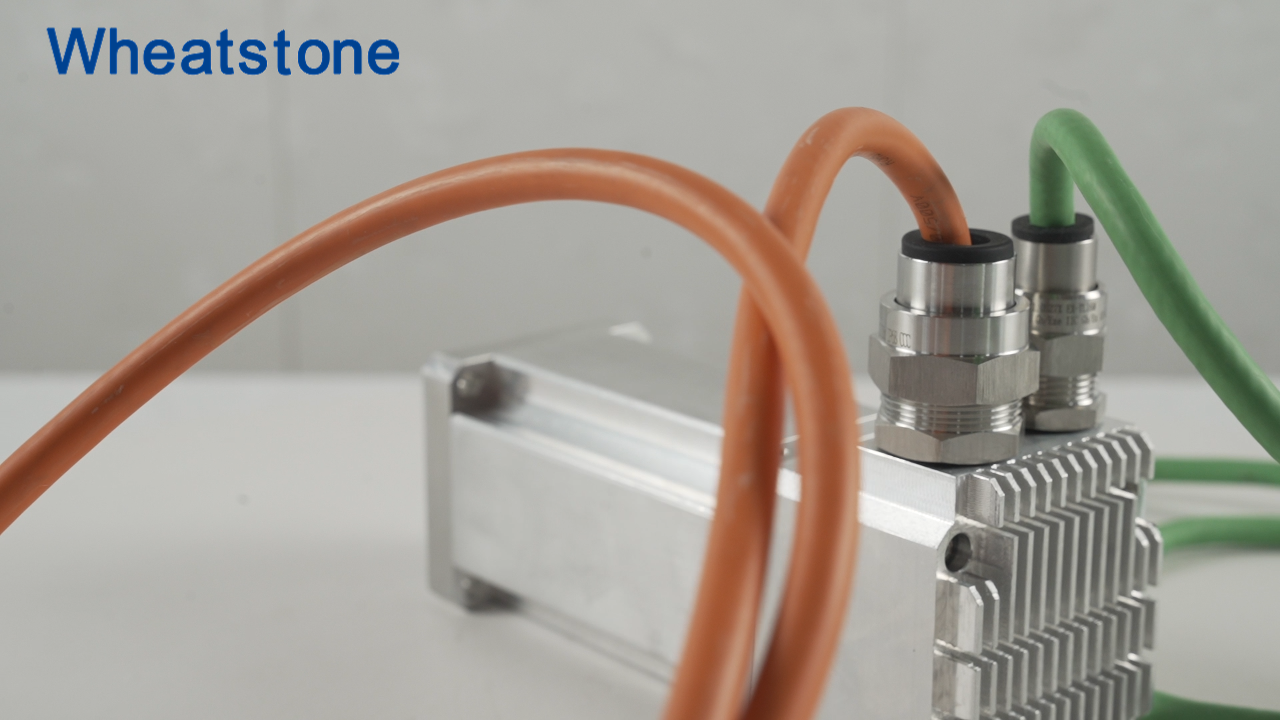
This is the most critical breakthrough. In Wheatstone's integrated units, the highest-heat-generating components—power devices—are physically isolated from the motor body. High-thermal-conductivity grease channels their heat to specially designed cooling fins on the housing, where air or process fluid carries it away. Field measurements show that under identical operating conditions, Wheatstone integrated units run 12-15℃ cooler at the housing than the separate drive cabinet surface. In a fine chemical continuous agitation application, the unit has operated for 36 months with power device temperatures consistently below 85℃, projecting electrolytic capacitor life exceeding 8 years.
Redesign 2: Interface Simplification
Wheatstone integrated units consolidate power input, bus communication, and encoder feedback into a single quick-connect hybrid cable. On-site installation: plug in one cable, tighten the locking nut, and the system is ready. In a lithium battery material plant retrofit in Jiangsu, replacing drives for 12 reactors was originally scheduled for 7 days—actual completion was 3 days. Installation labor dropped by 60%, and wiring-related failures fell to zero.
Redesign 3: Footprint Reduction
Through high-density integration, Wheatstone integrated units are over 40% smaller than separate configurations. In space-constrained applications—painting robot bases, valve actuators, AGV drives—this compactness often makes the difference between feasible and impossible. In an automotive parts factory painting line, switching to integrated units freed up space for an additional maintenance access walkway.
III. A Case in Point: From Three Days of Wiring to One Hour of Plug-and-Play
In 2024, an active pharmaceutical ingredient plant in Zhejiang launched a new production line. Six reactor agitator drives were specified with Wheatstone explosion-proof integrated servo motors.
Separate Configuration (Original Design Estimate) :
Each drive required a dedicated explosion-proof cabinet (approx. 0.6m² footprint)
Three cables per motor (power, encoder, brake)
Estimated wiring time per unit: 4 hours
Drive enclosure surface temperature in summer: up to 75℃
Wheatstone Integrated Configuration :
No external cabinets; motors mounted directly on reactor frames
Single integrated hybrid cable per unit
Wiring time per unit: 40 minutes
Motor housing surface temperature in summer: 52℃
The project lead calculated the savings: cabinet costs alone saved 60,000 RMB; installation schedule compressed from 14 days to 5 days. More importantly, the entire drive system no longer consumed valuable floor space, leaving room for future capacity expansion.
IV. Performance Comparison: Separate vs. Integrated
| Dimension | Separate Configuration | Wheatstone Integrated Servo Motor |
| System Footprint | Motor + control cabinet ≥0.6m² | Single motor, no additional footprint |
| Installation Time | 4-6 hours per unit | 40-60 minutes per unit |
| Number of Cables | 3 (power, encoder, brake) | 1 hybrid cable |
| Potential Failure Points | 6 glands, 12 terminals | 1 connector |
| Thermal Environment | Drive sealed in cabinet, high ambient | Heat source separation, housing directly cooled |
| Total Installed Cost | Motor + cabinet + high labor | Single unit, significantly reduced labor |
V. Why Integration Is the Future
Three drivers are accelerating the shift toward integrated explosion-proof servo motors:
The Edge of Industry 4.0
Future smart factories demand that every actuation point be a data node. Integrated units, combining motor and drive, are naturally equipped for condition monitoring and predictive maintenance. Wheatstone integrated units incorporate temperature and vibration sensors, streaming real-time operating data via bus communication—feeding predictive maintenance systems with essential field-level data.
The Space Constraint of Retrofits
Aging plants face one overwhelming constraint: space. Integrated units' "no cabinet" footprint makes them almost the only viable choice for many retrofit projects.
The Efficiency Imperative
Project timelines are shrinking. Installation efficiency directly impacts project profitability. The simplicity of integrated units is changing the pace of explosion-proof automation project delivery.
VI. Conclusion: Integration Is Evolution
The rise of explosion-proof integrated servo motors isn't a marketing story manufacturers invented. It's the solution engineers have been "pushed" toward through countless hours of installation, wiring, commissioning, and maintenance—a pragmatic response to real-world constraints.
For over two decades, Jiangsu Wheatstone has specialized in this space. From material selection to heat source separation, from interface design to process control, every engineering decision has been guided by one simple question: how to make automation in hazardous areas simpler, more reliable, and less demanding.
If you're planning an automation retrofit for hazardous areas, take a look at what the teams who have already switched to integrated units have gained. They've saved more than time—they've gained years of operational peace of mind.

 86-0519-86163211,86-0519-86163212







