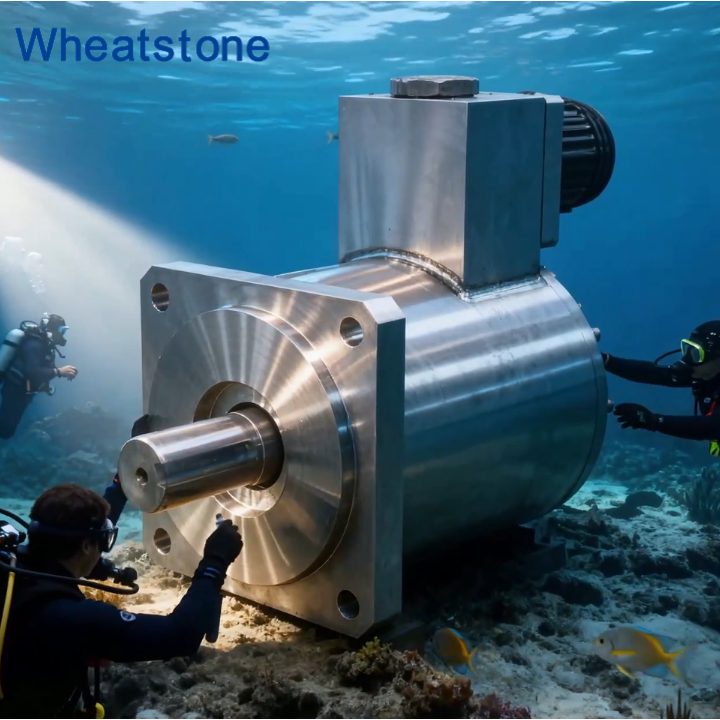
Waterproof Motors VS. Standard Motors: What's The Real Difference?
You are here: Home » Blog » Products & Technology » Waterproof Motors VS. Standard Motors: What's The Real Difference?
Waterproof Motors VS. Standard Motors: What's The Real Difference?
Views: 0 Author: Site Editor Publish Time: 2026-03-12 Origin: Site
At a seafood processing plant in Ningbo, maintenance technician Chen was dismantling a burned-out motor. The housing was rusted, water stains inside the junction box, winding insulation carbonized. He sighed: "Another water damage. Third one this year."
Chen's frustration is shared by many equipment engineers: How do waterproof motors differ from standard ones? Why do some motors last years near water while others fail in months?
Let's break down the real engineering.
I. Why Are Standard Motors Afraid of Water?
Standard motors were never designed to get wet.
Windings are the first weakness. Standard magnet wire has only a thin insulation coating. Fine in dry environments, but when moisture seeps in, microscopic pinholes in the varnish become conductive paths. Water itself conducts, and ions in water accelerate the process.
Materials are the second trap. Motor rotors and stators use silicon steel. This rusts when wet. Rust (iron oxide) expands to several times the original volume. Motor air gaps are measured in hundredths of a millimeter—once rust grows, rotor and stator contact. Seizure follows quickly.
Seals are the third weakness. Standard motor end bells might have paper gaskets. Junction boxes have plastic covers. Shafts exit with nothing but open air. Fine for dust, useless against water.
II. What Actually Makes a Motor "Waterproof"?
Waterproof motors aren't just standard motors wrapped in plastic. They're redesigned inside and out.
First Layer: Serious Sealing
Static seals use fluoroelastomer O-rings that won't deform under pressure. Housing joints aren't just bolted—they get specialty sealant that cures to withstand meters of water pressure.
Dynamic seals are the real engineering challenge. The shaft rotates, but water must stay out. Waterproof motors use double-face mechanical seals with silicon carbide faces—hardness second only to diamond. A micron-thick fluid film separates the faces, lubricating while sealing. Add a sand-slinging ring, and even sediment stays out.
Terminal seals use glass-sintered feedthroughs. Metal pins fused with specialty glass at the atomic level. Not even gas leaks through.
Second Layer: Real Materials
Waterproof motor housings aren't cast iron. They're 316L stainless steel with higher molybdenum content, pitting resistance double that of 304. All fasteners are A4-80 stainless—submerged for years without rusting.
For extreme marine environments, Wheatstone offers titanium alloy options. Titanium forms a dense oxide film in seawater, virtually immune to corrosion.
Third Layer: Insulation That Lasts
Waterproof motors use Class H insulation (180°C), not ordinary paper. Polyimide film and mica tape composites that maintain electrical properties from liquid helium temperature (-269°C) to 300°C.
The process is Vacuum Pressure Impregnation. Stators go into vacuum chambers, air and moisture extracted, then specialty solvent-free varnish injected under pressure, filling every void. Finally, rotating oven curing ensures uniform thickness, zero bubbles.
Fourth Layer: Water-Based Cooling
Submerged motors use water as their cooling medium—water's specific heat capacity is four times that of air.
Wheatstone's design features helical cooling fins on the housing, maximizing surface area as water flows past. Higher-power motors use composite cooling: stator back with water jacket, rotor cavity filled with heat conduction oil circulating through a hollow shaft.
IV. Real Case: A Wheatstone Motor After Two Years Underwater
Last year, a marine engineering facility in Zhoushan inspected a Wheatstone deep-sea motor after two years on an ocean observation network at 50 meters depth. It survived typhoon-driven currents and winter waters below freezing.
The inspection told the story: stator interior pristine, winding insulation above 500MΩ, bearing grease fresh, seals still supple. The lead technician commented: "Two years submerged, cleaner inside than some motors on dry land."
That motor was a Wheatstone WDU series with fully sealed pressure-balanced construction, double mechanical seals, titanium alloy housing,导热 oil filling, and embedded temperature/leak sensors.
Final Thoughts
The difference between waterproof and standard motors isn't "can it get wet." It's "can it survive underwater." Every barrier—sealing, materials, insulation, cooling, protection—has to hold.
Wheatstone has spent two decades in this game. From -196°C to +200°C, from vacuum to 3000 meters deep, from explosion-proof to radiation-resistant—the data and experience accumulation in every motor.
If you're looking for motors that can go underwater—100 meters or 1000, freshwater or salt—let's talk. Wheatstone's engineering manual contains dozens of sealing solutions and hundreds of material combinations. Maybe the perfect one is waiting for your project.
Contact Jiangsu Wheatstone:www.wheatstonemotor.com. Ask for an engineer directly. We're happy to talk through the details.

 86-0519-86163211,86-0519-86163212