At a deep-sea equipment testing facility in Zhoushan, engineer Wu disassembled a thruster motor recovered from 3,000 meters deep. Inside, it was dry. The winding insulation data matched factory records. This motor had run continuously for two years at the bottom of the ocean.
Wu pointed at the gap between the stator and rotor: "0.5 millimeters—we call it '50 millimeters' in the trade. Any bigger and efficiency drops. Any smaller and it risks seizing. The real engineering of underwater motors is in the details you can't see."
I. Why Must They Be Sealed? What Happens When Water Gets In?
Underwater motors must be sealed for one simple reason: water conducts electricity and acts as an abrasive.
In brushed motors, water entering creates an immediate short circuit between the brushes and commutator. Brushed motors rely on mechanical contact; water provides a conductive path, causing sparking and rapid failure.
Brushless motors are slightly better—windings are typically epoxy-encapsulated, so water doesn't cause instant shorts. But there's another problem: water creates massive drag.
Water is 800 times denser than air and 50 times more viscous. A rotor spinning in water faces enormous resistance. Tests show brushless motors flooded with water rarely exceed 70% efficiency—often much lower. Worse, salt and impurities in seawater wear down bearings and rotors, drastically shortening motor life.
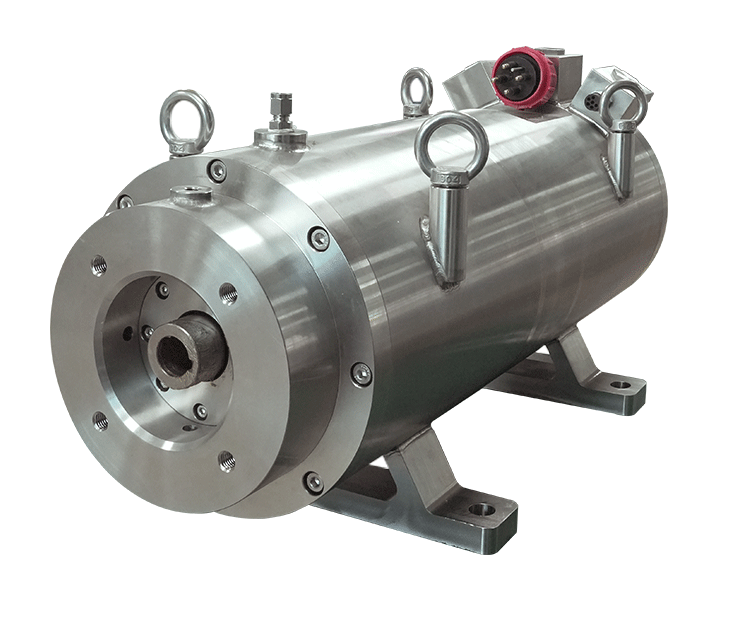
Wheatstone deep-sea motors use fully sealed construction to keep water out entirely. Housing joints feature fluoroelastomer O-rings plus specialty sealant. Shaft seals use multiple stages of silicon carbide mechanical seals. Cable entries use glass-sintered terminals—metal pins fused with specialty glass at the atomic level. Not even gas leaks through.
II. Why Fill with Oil? What's the Point of Liquid-Filled Motors?
Filling deep-sea motors with oil or water serves two critical purposes: pressure compensation and cooling.
Every 10 meters of seawater adds one atmosphere of pressure. At 3,000 meters, external pressure exceeds 300 atmospheres. If the motor interior were empty, the housing would need to be massively thick to avoid implosion.
Wheatstone uses pressure-compensated sealing technology: the motor interior is filled with high-insulating oil, connected to seawater through a flexible bladder. As depth increases, external pressure rises, the bladder compresses, and internal oil pressure rises in perfect balance. The housing doesn't bear the pressure differential—it can be lighter, and seals don't deform from extreme pressure differences.
Oil also aids cooling. Deep water has no convection; heat only escapes through conduction. Oil fills internal voids, carrying heat from windings and bearings to the housing, where seawater carries it away. Wheatstone uses high-thermal-conductivity oil with helical cooling fins, boosting heat transfer efficiency by over 40%.
Oil-filled motor design requires careful selection of fluids and seals. Wheatstone chooses high-insulation, low-viscosity oils that maintain electrical safety while minimizing rotational drag.
III. The Science of 0.5mm: Why Are Stator and Rotor So Close?
The gap between stator and rotor is typically designed around 0.5 millimeters—"50millimeters" in industry slang. This distance represents a carefully optimized trade-off.
Smaller gaps mean lower magnetic reluctance and higher efficiency. Magnetic flux crossing the air gap faces resistance; every fraction of a millimeter increases magnetic circuit losses.
But gaps can't be too small. Bearings have tolerances. Rotors experience centrifugal forces. Temperature changes cause thermal expansion. If the gap is too tight, rotor and stator can touch—causing noise, vibration, and potentially catastrophic seizure.
0.5 millimeters is the sweet spot honed by decades of motor design experience. It keeps magnetic losses acceptable while providing safety margins for mechanical deformation and thermal expansion.
IV. Efficiency Calculation: A Simple Formula
Underwater motor efficiency can be estimated with a simplified formula:
η ≈ P_out / (P_out + P_loss)
Where:
P_out: output power in watts
P_loss: total losses including copper losses, iron losses, and mechanical losses (including fluid drag)
For a flooded brushless motor, mechanical losses skyrocket. Fluid drag losses can be approximated by:
P_fluid ≈ k × ρ × n³ × D⁵
Where:
ρ: fluid density (water is 800× air)
n: rotational speed
D: rotor diameter
k: structure-dependent constant
This formula shows why sealing matters: for the same motor, fluid drag losses in water can be tens or hundreds of times higher than in air.
Example: A motor with 90% efficiency in air has 100W total losses. If flooding adds another 100W of fluid drag, total losses become 200W, and efficiency drops to:
η = 900 / (900+200) ≈ 81.8%
With higher drag, efficiency can easily fall below 70%.
V. Wheatstone Deep-Sea Motor Selection Guide
| Series | Depth Rating | Power Range | Sealing Method | Cooling | Typical Applications |
| WD Series | ≤500m | 1.5-55kW | Mechanical seals + O-rings | Passive water | ROVs, underwater cleaning |
| WDU Series | ≤3000m | 7.5-132kW | Pressure compensation + dual mechanical seals | Oil composite | Deep-sea observatories, mining vehicles |
| WDU-P Series | ≤8000m | Custom | Isobaric sealing + glass-sintered terminals | Forced oil circulation | Hadal zone exploration, full-ocean-depth equipment |
Final Thoughts
Underwater motors aren't just standard motors wrapped in waterproofing. Sealing, oil filling, air gap control—every detail represents decades of accumulated experience.
Wheatstone has spent nearly two decades in deep-sea motors. Material selection, seal design, pressure compensation, efficiency optimization—every motor passes rigorous pressure testing and long-term validation. If you're struggling with power system selection for deep-sea equipment, the Wheatstone technical team offers full-spectrum support from design to field service. We're happy to talk deep-sea power.
Technical consultation: Contact Jiangsu Wheatstone Mechatronic Technology engineers directly.

 86-0519-86163211,86-0519-86163212







