Just before the mass production of Tesla's Optimus humanoid robot, engineers encountered a stubborn problem: three motors crowded into the hip joint, drawing over 500 watts of power. Temperatures rose too fast, causing frequent robot shutdowns . Traditional air cooling was helpless. The only solution was a combination of liquid cooling and phase-change materials .
This scene is playing out across multiple industries simultaneously: AI data centers pushing past 30kW per rack, air cooling hitting its limits ; 800V platforms in electric vehicles generating heat faster, making liquid cooling standard ; industrial robots running 24/7, their joint life directly limited by cooling capacity .
Liquid-cooled motors are transitioning from "optional" to "essential."
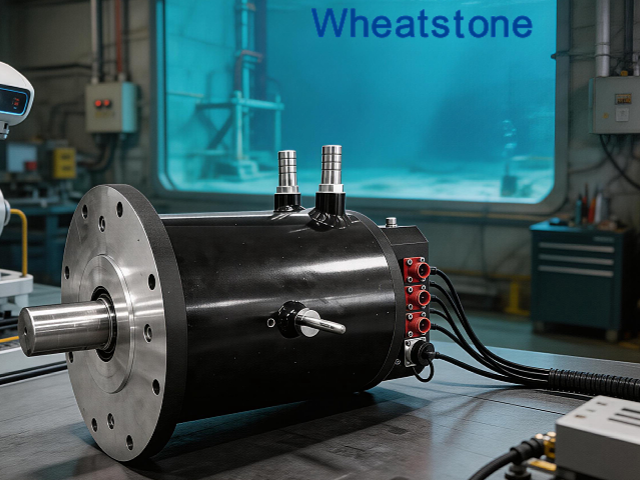
I. Why Has Liquid Cooling Suddenly Become Essential?
From a thermodynamics perspective, liquid cooling's advantages are overwhelming. Water's specific heat capacity is four times that of air; its thermal conductivity is 25 times higher . For the same volume, liquid cooling carries away 3 to 5 times more heat than air cooling .
But that's not the fundamental reason for liquid cooling's surge. The real drivers are three trends:
Power Density Keeps Climbing
Whether in humanoid robot joints, EV traction motors, or AI server power supplies, the direction is clear: smaller volume, more power. Tesla's humanoid robot hip joint exceeds 500 watts. Without liquid cooling, core temperatures hit 80°C, torque drops 30% . With liquid cooling, temperatures stay at 40°C, and joint life extends from 5,000 hours to 20,000 hours .
Space Is Extremely Constrained
Robots must mimic human proportions—there's no space in the joints for fans and heatsinks. Liquid cooling allows heat to be "transferred" elsewhere for centralized management . Research teams have proposed centralized liquid cooling, positioning all actuators above the knee with a unified cooling unit, reducing pipeline connectors by six and significantly lowering leak risk .
Higher Environmental Adaptability
In deserts, mines, and deep seas, air cooling is unreliable. Liquid cooling systems are closed-loop, unaffected by external conditions .
II. Market Data Tells the Same Story
According to Global Info Research, global liquid-cooled motor revenue was approximately $372 million in 2024, projected to reach $526 million by 2031, with a CAGR of 5.1% . Another report predicts the global EV thermal management market will exceed $120 billion by 2036, with liquid-cooled integrated systems accounting for over 65% .
Data center cooling demand is even more urgent. With the AI computing explosion, traditional air cooling can no longer handle high-density racks. Rack-level liquid cooling distribution units are becoming standard in new data centers .
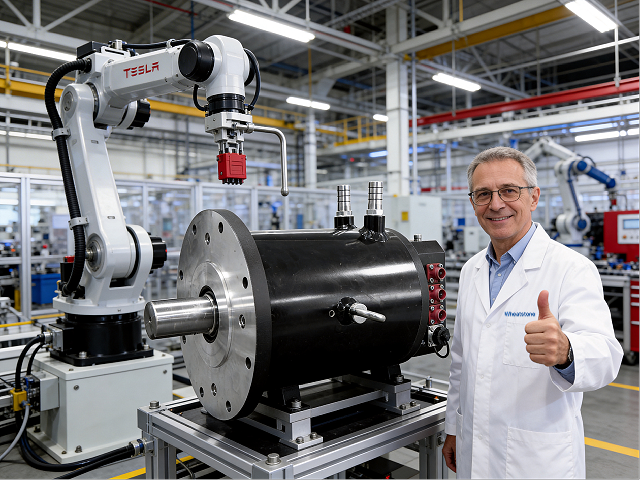
III. The Evolution Path of Liquid Cooling Technology
Liquid-cooled motors aren't a single technology—they're evolving along several parallel paths:
Internal vs. Surface Cooling
Internal cooling places cooling channels close to the stator windings, removing heat before it spreads. It's the most efficient but hardest to manufacture . Surface cooling wraps a cooling jacket around the housing. It's simpler, but the thermal path is longer . Wheatstone's WCS series water-cooled servo motors feature internal spiral water channels, with coolant flowing directly against the stator back—thermal efficiency 40% higher than surface cooling.
Centralized vs. Distributed Cooling
Robotics is exploring centralized liquid cooling, collecting heat from multiple drives for unified treatment, reducing pipeline complexity. Wheatstone's integrated liquid cooling solution for collaborative robots combines motor, gearbox, and cooling channels into one module—volume reduced by 30%, cooling capacity doubled.
Phase-Change Composite Cooling
A recent patent from Chery combines heat pipe phase-change cooling with liquid circulation. Phase-change materials absorb large amounts of heat, then liquid carries it away . This composite cooling significantly reduces peak temperature rise inside motors. Wheatstone's WDU series deep-sea motors use oil-water composite cooling, operating continuously at 1,000 meters depth with winding temperatures within safe limits.
IV. Where Is the "Ultimate Limit" of Liquid Cooling Technology?
From a technology evolution perspective, liquid cooling has four development directions:
More Efficient Cooling Media
From water to oil, from fluorinated fluids to liquid metals—coolants themselves are evolving. 3M's fluorinated fluids can directly contact live components, enabling immersion cooling . Wheatstone's high-temperature motors use thermal oil cooling, rated above 200°C.
More Integrated Structural Design
Cooling and structural functions are merging. Some research teams embed cooling channels directly into robot skeletons, achieving "structure as heatsink" . Wheatstone's integrated water-cooled motors feature cooling jackets cast integrally with the housing—reliable sealing, lower thermal resistance.
More Intelligent Control Algorithms
Temperature sensors plus AI algorithms enable on-demand cooling. Low load, reduce flow; heavy load, full cooling—saving energy while maintaining performance . Wheatstone's premium liquid-cooled motors come standard with PT100 temperature sensors and intelligent control interfaces, automatically adjusting cooling power based on winding temperatures.
More Extreme Applications
The ultimate limit isn't in labs, but in places humans haven't fully conquered: deep sea, space, nuclear reactors. Wheatstone's deep-sea motors have run continuously for two years at 1,000 meters depth—zero cooling system failures.
V. Wheatstone Liquid-Cooled Motor Selection Guide
| Series | Cooling Method | Power Range | Applications | Key Features |
| WCS Series | Internal water | 1.5-55kW | Robots, reciprocators, servo drives | Spiral channels, Class H insulation, PT100 sensors |
| TBYC-W Series | Jacket water | 7.5-315kW | Pumps, fans, compressors | Integrated water jacket, Class F/H insulation |
| WDU Series | Oil-water composite | 7.5-132kW | Deep-sea equipment, high-temp environments | Pressure compensation, dual-loop system |
| Custom Series | Custom | Custom | Special applications | Phase-change materials, immersion cooling |
Final Thoughts
Will liquid-cooled motors become mainstream? In some fields, they already are. Humanoid robot hips, AI server power supplies, 800V traction drives—in these places, without liquid cooling, they simply can't run.
Where is the ultimate limit of liquid cooling? Beyond the cold plates, coolants, and pumps—the real limit is a system-level thermal management mindset: from "motor cooling" to "heat transportation," from passive temperature reduction to active thermal control, from individual components to whole-system synergy.
Wheatstone has nearly two decades of experience in liquid-cooled motors. From shallow water to deep sea, from ambient to high temperature, from standard to custom—every liquid-cooled motor passes rigorous seal testing and thermal balance validation. If you're struggling with heat in high-power-density applications, let's talk. Our engineering files contain dozens of liquid cooling solutions and hundreds of case studies.
Contact Jiangsu Wheatstone:wheatstonemotor.com Ask for an engineer directly.

 86-0519-86163211,86-0519-86163212







