From ambient temperature to internal rise, how are motors classified?
Next to a continuous casting line in a steel plant, the thermometer reads 45°C. An engineer touches a running motor housing with the back of his hand—he pulls back after just two seconds. "Too hot!" he frowns. The surface temperature is at least 65°C, but what he doesn't know is that inside, the winding temperature is already approaching 120°C.
This scene plays out daily in factories across the country. Everyone relies on touch to "feel" motor temperature, but few truly understand: ambient temperature, housing temperature, internal temperature—what's the difference? And how does this difference determine whether a motor can survive—and for how long?
I. Temperature Rise: The Motor's Real "Thermometer"
Let's start with a fundamental concept: temperature rise.
Temperature rise is simply defined as motor temperature minus ambient temperature. For example, if ambient is 30°C and the motor stabilizes at 110°C, the temperature rise is 80K (Kelvin, numerically the same as Celsius).
Why emphasize temperature rise rather than absolute temperature? Because motor life is directly tied to it.
There's a brutal "10-Degree Rule" in motor engineering: For every 10°C increase in winding temperature above the insulation class limit, insulation life is halved. A motor designed for 20 years of life, operating continuously 10°C above its rated temperature rise, will actually last only 10 years.
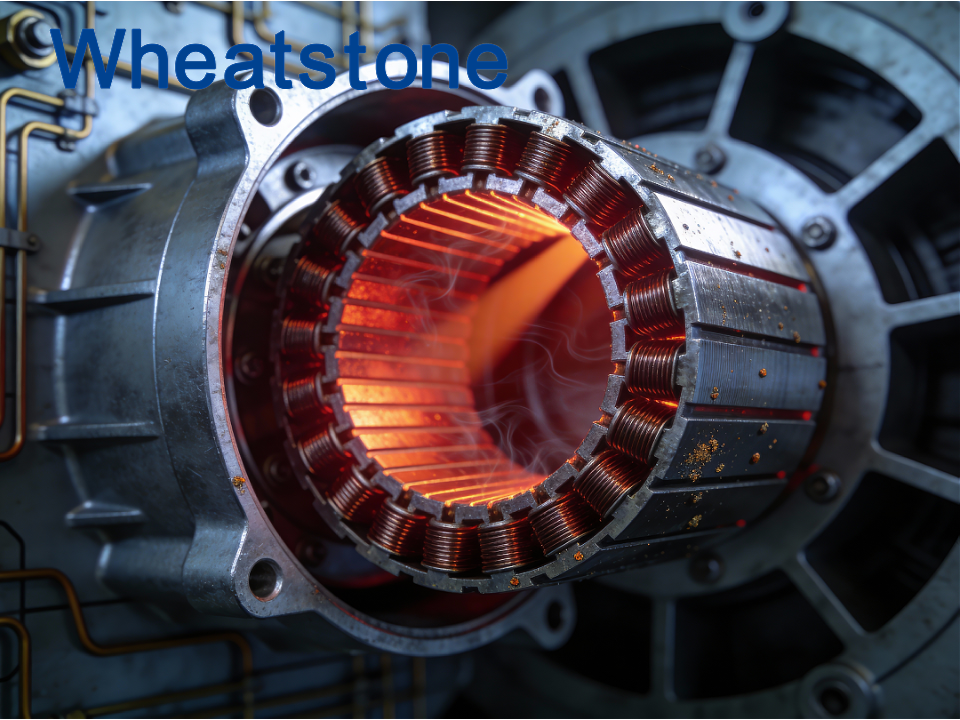
And motor internal temperatures are never uniform. Winding ends can be 10-20°C hotter than the slots, rotor temperatures differ from the stator, and bearings have their own thermal profile. The path of heat conduction determines the temperature difference between inside and outside-1.
II. Motor Classification: "What They Wear" Depends on "Where They Work"
Motor design fundamentally answers one question: Where does the heat come from, and where does it go?
Based on operating environment temperature, motors fall into several categories, each with its own "wardrobe."
General Purpose Motors (-20°C to +40°C)
These are the most common—eight out of ten motors in a typical factory. Designed for 40°C ambient, Class B (130°C) or Class F (155°C) insulation, relying on fans for cooling. They run fine in room temperature workshops, but put them in a high-temperature environment, and they quickly overheat.
High-Temperature Motors (+80°C to +200°C, and beyond)
High-temperature motors face two major technical barriers: magnets and insulation-2. Standard NdFeB magnets start demagnetizing at 150°C; standard insulation varnish carbonizes above 180°C. So high-temperature motors need different gear:
Magnets: Switch to Samarium Cobalt (SmCo). Temperature coefficient of remanence is only -0.03%/°C, flux decay less than 5% at 200°C, can handle up to 350°C.
Insulation: Go to Class H (180°C) or even Class C (200°C+), using polyimide film, mica tape—materials that laugh at heat.
Lubrication: Standard grease evaporates above 150°C. Use perfluoropolyether (PFPE) grease, good to 300°C.
Low-Temperature Motors (-60°C to 0°C)
Low temperatures bring different challenges. Materials get brittle, grease solidifies, starting torque can spike to three times normal. Low-temperature motors need their own gear:
Housings: Not Ordinary aluminum alloy. Austenitic stainless steel or Low temperature toughness aluminum (like 5083-H321), retaining toughness down to -100°C.
Bearings: Low temperature steel (e.g., 9Cr18Mo) with special heat treatment.
Lubrication: Polyalphaolefin (PAO) or silicone-based grease, working down to -80°C-7.
Anti-condensation: Nitrogen purging or anti-condensation heaters to prevent icing during shutdown-7.
Wide-Temperature Range Motors (-60°C to +200°C)
These are the toughest. From Arctic cold to desert heat, materials must withstand both embrittlement and thermal expansion. Thermal expansion coefficient matching is critical—ceramic bearings expand only one-third as much as steel, maintaining clearance through wild temperature swings-8. Lubrication uses wide-temperature PFPE grease, working from -60°C to 200°C.
III. Cutting-Edge Cases: Wide-Temperature Motors in Action
Case 1: NASA's Lunar Rover Motors (-180°C to +125°C)
NASA's DEEDS project develops extreme environment drive systems for lunar and Mars rovers. Lunar surface: 125°C day, -180°C night—a temperature swing of over 300 degrees.
The project uses several black technologies:
Bulk Metallic Glass (BMG) Gears: Minimal wear at cryogenic temperatures, can even run without lubricant, surviving dozens of deep thermal cycles at -180°C.
Cryogenic Electronics: Components selected to operate at -180°C without survival heating, saving power and mass.
Dual Resolver Sensing: Ensuring precise positioning under extreme temperatures.
Target life: over 5 years, minimum 50 km traverse.
Case 2: Antarctic Research Station Motors (-60°C)
Solar tracking mounts at China's Antarctic research stations use Wheatstone custom Low temperature motors. Special low-starting-torque rotors (0.2N·m) perform hundreds of daily angle adjustments at -55°C, running for three years without failure.
Case 3: Refinery Heavy Oil Pump Motors (180°C)
A catalytic cracking unit's circulation pump operates in 150°C+ ambient. Wheatstone high-temperature motors use SmCo magnets and Class C insulation, with stator cores coated in alumina ceramic for rapid heat conduction. Two years continuous operation, winding temperatures consistently below 155°C—double the life of conventional motors.
IV. Wheatstone High/Low Temperature Motor Selection Range
| Series | Temperature Range | Typical Applications | Key Configurations |
| HT Series | -40°C to +200°C | Steel casting, glass conveying, refinery pumps | SmCo magnets, Class H/C insulation, PFPE grease, water/air cooling |
| LT Series | -60°C to +80°C | Antarctic research, LNG, cold storage | Low temperature steel bearings, silicone grease, anti-condensation heaters |
| WT Series | -60°C to +200°C | Space simulation, desert oil fields, outdoor unmanned | Titanium alloy housing, ceramic bearings, intelligent thermal control |
Final Thoughts
Back to the opening question: When a motor feels hot to the touch, what's the actual temperature inside? The answer: 60°C on the housing could mean 120°C inside. That 60°C difference is "temperature rise." It determines motor life, and it determines motor classification.
General-purpose motors run fine in room temperature workshops. But put them in high-temperature furnaces, and you need high-temperature motors. Send them to Antarctic research stations, and you need Low temperature motors. Launch them to the Moon, and you need wide-temperature-range motors.
Wheatstone has spent over a decade Accumulate hard-won experience in these extreme environments. If you're looking for motors that can handle the heat, withstand the cold, or survive both, let's talk. Our engineering manual might have exactly the page you're looking for.
Contact Jiangsu Wheatstone: www.wheatstone.com.Ask for an engineer directly. We're happy to talk through the details.

 86-0519-86163211,86-0519-86163212







